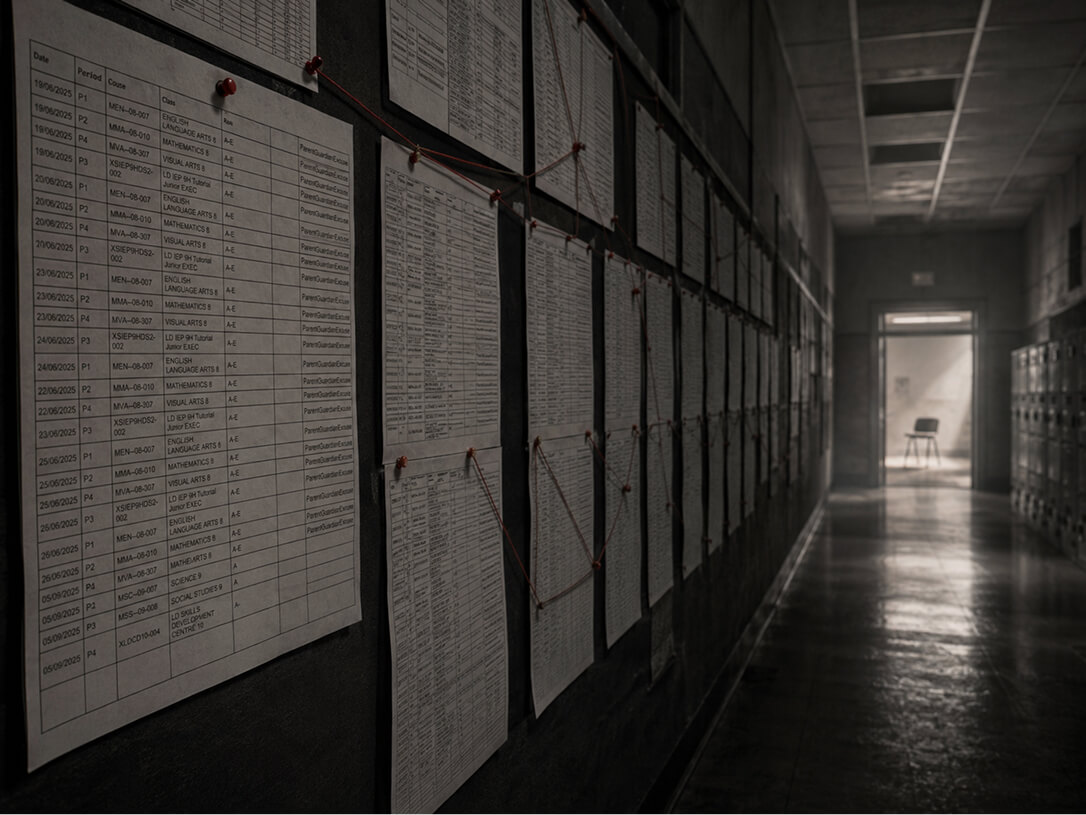
There is no real way to alleviate the pain you feel as a parent or caregiver when your child is struggling and not receiving the support they need, or is being actively harmed at school.
It can eclipse everything. I make mistakes at work. I find it hard to have an empathetic conversation with a friend because so much of me is still occupied by what is happening at school. I feel like the loneliest person alive.
The progression of school advocacy can feel like a bad dream that just keeps happening. Another meeting, another request for proof, another morning when you have to work out whether your child can go back. After a while, it can feel as though you have no agency in your own life. Life keeps happening to you.
During one of those low stretches, I dusted off a few resources that had come to mind. If I couldn’t stop the painful experience, perhaps I could at least find words to explain what was happening. To know that it wasn’t just me—that these experiences formed a systemic pattern, shaped by how schools are designed—didn’t make it stop. But it made me feel less alone, and helped me see where the responsibility belonged.
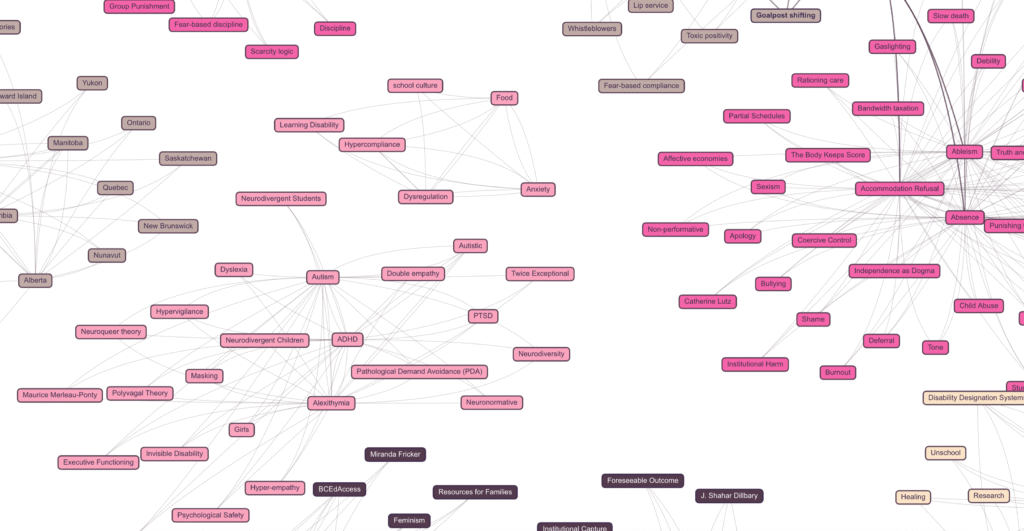
The alphabetical tag index helps readers find a subject; the interactive tag map lets them open a definition and follow related writing.
Access: what is the child actually receiving?
Meaningful access is more than enrolment, a place on a class list, or permission to enter a building. A child needs a genuine opportunity to learn and participate. If they can be present only by enduring pain, panic, humiliation, or unmet disability-related needs, we have to ask what kind of access they have been given. See duty to accommodate and student exclusion.
- Accommodation refusal can be an obvious no, but it can also take the form of indefinite deferral: a support acknowledged in a meeting that never reaches the classroom, or an interim arrangement that never acquires an end date. The useful question is, What will the child be able to access tomorrow, with the supports available tomorrow?
- Compliance over care describes the moment when looking manageable becomes the measure of whether a child is doing well. A student who stays quiet may receive praise while using all their energy to get through the day. A child who shows distress may receive consequences when the unmet need behind it deserves attention. The difference between outward behaviour and actual wellbeing matters.
- Masking and hypercompliance help explain why school and home accounts can differ without either being false. A child may hold themselves together until they reach the car, then fall apart. Their ability to conceal distress at school does not tell us what it costs them, or whether the environment is sustainable.
- Student exclusion is not limited to a formal suspension. Repeated requests for early pickup, a shortened day without a path back, or long stretches spent outside the classroom can all reduce access to education. The details matter: who initiated the removal, what learning was offered, how the time was coded, and who is responsible for the return plan.
- Collective punishment has a specific meaning: a group receives a consequence for the actions of one or a few. When a whole class loses recess because one child struggled, the practice also teaches peers whom to blame. Not every exclusion is collective punishment. Naming the practice accurately helps us see both the direct harm to the group and the social harm to the child made responsible for it.
Scarcity: who pays for what is missing?
- Scarcity logic turns a limit on staffing, time, space, or money into a limit on what a child may reasonably ask for. Staff may be working under genuine constraints. The point is to keep those constraints visible as institutional conditions, rather than describing the child’s needs as the problem.
- Rationing care occurs when support arrives only after distress becomes impossible to ignore, or when children must prove they are struggling more than someone else. A child should not have to reach crisis to be believed. Ask what early support was considered, what was available, and why it was not provided.
- Performative accessibility is the gap between a stated commitment and a child’s ordinary Tuesday. A plan can name inclusion, belonging, and regulation while the actual supports are unavailable, unfamiliar to staff, or conditional on the child already coping. The test is implementation: who does what, at what time, with what backup when the first plan fails?
- Parent as procedural proxy names the unpaid work that keeps a child’s education going when the system does not: repeated pickups, coordinating specialists, explaining the plan to each new staff member, correcting records, and documenting decisions. Siblings may also be drawn into care work they never agreed to do. The cost does not disappear when it leaves the school budget; it moves into a household and, often, a workday.
- Scapegoating makes one child appear to be the reason everyone else is losing time, safety, or opportunity. Children and teachers may both be living with the effects of missing supports. When the shortage is made to look like a child’s character flaw, families who need the same well-supported classroom are encouraged to see one another as competitors. They may be describing the same failure from opposite sides of a door.
Records and procedures: what does the system remember?
- Euphemism is language that softens an action until its consequence is hard to see. A “reset at home” might mean a child was sent away for the day. A “temporary schedule” might become months of missed instruction. The remedy is to describe the action and its effect plainly, alongside the school’s preferred term.
- Information asymmetry means the institution holds records, internal discussions, and decision routes the family cannot easily see. Families and caregivers may have to reconstruct a school day from calls, messages, and what a child can tell them afterwards. Asking for the decision, the record of it, and the material relied on makes the account more complete.
- Documentation burden is what happens when families must repeatedly supply evidence the institution already has, or maintain a parallel archive because the official record omits the reason a child was sent home. Documentation can protect a child. It also takes time and energy that the family did not choose to spend.
- Shadow procedures are informal routes that do real work without clear decision makers, records, or timelines. A concern can be passed from teacher to principal to district staff through a series of conversations, while nobody makes an appealable decision or commits to a remedy. The family is told the matter is being addressed, but cannot tell when it will be resolved.
- Coercive proceduralism describes a process that requires more meetings, forms, and repetition from the people already carrying the harm. Process is necessary when it leads to a fair decision and a remedy. It becomes an obstacle when the child waits without interim support and the family must keep proving the same point. Every proposed step should have a purpose, an owner, and a date.
- Goalpost shifting occurs when the condition for help changes after a family has met the last one: first a report, then another observation, then a new meeting, then evidence that the child can attend consistently before support is offered. Put the current requirement and decision date in writing. If the standard changes, ask who changed it and why.
- Institutional amnesia is the yearly reset that makes a family retell the history of failed plans, exclusions, and lost trust. A new teacher may genuinely be new to the story; the institution is not. Continuity requires a usable handover and an account of what has already been tried. The child should not have to repeat the harm for the pattern to count. See institutional harm and information asymmetry.
Accountability: what changes after harm is named?
- Tone policing shifts attention from a child’s access to whether a caregiver raised the concern pleasantly enough. Respectful communication matters, but an uncomfortable email does not answer the question it contains. Return to the decision, its effect on the child, and the remedy requested.
- Institutional betrayal describes the additional harm when a trusted institution learns about an injury and responds by minimising it, disbelieving the child, or protecting its own account of events. An apology may matter. So do accurate records, protection from recurrence, and a way for the child to participate safely again.
- Repair and reflection must be more than asking a child or family to rebuild trust on their own. Repair has practical content: restore instruction, provide the agreed support, correct a misleading record, name who will follow through, and set a date to check whether the change is working. It should reach the conditions that caused the harm, not only the feelings that followed it.
Use the words to ask better questions
A term is useful when it helps a family, a teacher, or a decision maker locate responsibility more accurately. “Exclusion” asks who asked the child to leave and what education continued. “Documentation burden” asks why a family is proving the same fact again. “Scarcity logic” asks whose decision left staff without what they needed. “Repair” asks what will be different on Monday.
We do not need a specialist term for every injury. Sometimes the plain account is enough: My child was sent home. The record says I excused them. They missed the lesson, and there is no plan for tomorrow. The vocabulary should make that account harder to dismiss, not harder to say.
The tag archive will keep growing. So should these definitions, as families and caregivers, students, and educators test them against what happens in classrooms and homes. Without a word for school-initiated absence, a lost school day can become a family choice in the official record. Without a word for the work of contesting that record, the family’s exhaustion can look like a private problem. Naming the pattern changes neither fact by itself. It gives us a way to insist that the institution account for both, while the child is still entitled to a place in the room.