The body keeps the account even when the institution refuses to. What the school system produced in the parent who spent years trying to hold it accountable is not caregiver burden — a word that belongs to the person carrying it — but iatrogenic harm: specific, dated, attributable, and fully known to the institutions that continued to produce it after the disclosures were made. The record is here.
Section 1: Opening — the chronicle
I have been keeping records since before I knew why.
As a child I saved ticket stubs and report cards and notes passed in class. The kind of detritus that accumulates around someone who is compelled to make the ephemeral permanent. I might be imaginary, unless I prove I was there. I would insist through the accumulation of evidence, that things had happened and mattered.
I understand now that this is an autistic trait. A nervous system wired to notice, to retain, to correlate, to build meaning from the sediment of daily life. In my family, everyone knew to give me the birthday cards and the family photographs. The archivist. The chronicler.
It is also why building an archive of eight hundred thousand words documenting school exclusion practices across BC was the thing I was always going to do. The emails and the diary entries and the scraps of paper and the photographs were always going to accumulate into something.
I have been scrolling through photo highlights lately. I noticed that my feed used to look different.
There is a video of my son at four years old. He is delivering a monologue in his fancy vocabulary. Precise, delighted, entirely himself. The world opening outward in every direction simultaneously.
There are photographs from Tofino. My children’s small pink faces against the grey-green Pacific, turned into the wind defiantly, albeit blue lips.
First steps. First words.
The photographic record of a mother who documented her children’s precocious milestones with the journalistic compulsion of someone who understood, instinctively, that these moments might feel like the highlight of our life someday.
I used to smirk at the 40 Under 40 list. I assumed that my name would be on it one year. I was at events. I was in rooms. I rubbed elbows. I held the Olympic torch. I ran long distances and worked long hours.
The photographs of my children become less frequent. They grow weary of being documented — they know they exist without evidence. I made them believe they are real without any hard proof.
The occasions thin. The milestones quiet.
My son has not really left his room since February 2025. His skin has the pallor of someone who has not seen sustained sunlight in months. Fish-belly white. Acne flaring.
My daughter is fighting to be in a classroom at all.
No photos please.

Now the photographs are of prescriptions. Supplements arranged on a kitchen counter — berberine, bitter melon, mastic gum, the small amber bottles of a metabolic management protocol that did not exist in the Tofino photographs. A knee brace, worn and familiar. A neck brace against bare skin. A printout — an A1C reading, the number that tells the story of a body under sustained institutional load, climbing year by year through the elementary school years, through the secondary school transitions, through the complaint processes and the FOI requests and the stress leave that finally arrived when the body could no longer absorb what was being required of it.
A coffee-stained countertop. A half-empty glass of wine.
The 40 Under 40 did not happen. Career fractures.
Some mornings I think about the cardiovascular risk profile of sustained chronic stress in someone with my metabolic vulnerabilities. I could die from this. As a clinical possibility — the heart attack at the end of a trajectory that began in fluorescent rooms and folded hands and the somatic cost of translating your child’s suffering into the institutional language required to be heard, and being unheard anyway, and returning the following week to try again.
-

Epistemic silencing of disabled children’s primary caregivers
Epistemic silencing in BC schools discredits mothers’ knowledge, reframes advocacy as aggression, and erases disabled children’s pain, leaving families punished for truth.
Here is what I want to name before the theoretical apparatus and the legal analysis and the taxonomic precision of the sections that follow: the counterfactual.
I know plenty of parents for whom it has simply been hard — the ordinary hard of parenting. I cannot know with certainty what our version of that hard would have looked like. What I know is what was foreclosed. The specific, documented closing off of possibility etched on my son’s body, on my metabolic record, on a feed that used to hold a four-year-old delivering monologues and now holds prescription bottles.
The question is not whether it would have been easy. The question is whether this — this specific trajectory, this documented deterioration — was necessary.
The answer to that question is written down in every legal obligation the institution chose not to meet.
What if it had simply been fair?
My son would have colour in his face. My daughter would be in a classroom, engaging the world with the delight and intellectual hunger that were always her defining features before the system spent years teaching her that the world was a place that would harm and diminish and exclude her. The four-year-old giving monologues with high school vocabulary would have had those capacities met and extended and honoured by an institution mandated to do exactly that. My career would be intact. My A1C would tell a different story. My feed would look different.
That choice — specific, documented, legally unjustifiable, physiologically costly, sustained across years with full knowledge of what it was producing — is what this paper is about. The choice. The institution’s choice. The choice that is still being made, in school districts across this province, in the bodies of mothers who are keeping records and keeping faith and keeping themselves alive against the actuarial odds of what sustained institutional stress does to bodies like ours.
Section 2: on theoretical explanations
When I feel especially grim, I look for literature. Since university days, I have found that systems that can explain the phenomena of our daily lives help me find meaning and make sense of suffering. Many times, over the years of sending my children to public schools, I have searched for sages. Someone who can explain the experience of our material existence.
This section introduces the theorists who changed how I understood what was happening to us.
Jasbir Puar and the slow erosion of the body
There is a word my mother used when she wrote sick notes for me during my own school collapses. Not sick. Not unwell. Decapacitated. She chose it with care, the way she chose all her words — because it named something that sick could not: not an acute event, but a state; not a diagnosis, but a condition produced by conditions. A body worn to its threshold by sustained exposure to something it was not designed to withstand.
Jasbir Puar’s The Right to Maim: Debility, Capacity, Disability gave me the theoretical architecture for what my mother had named intuitively. Puar draws a distinction that the medical and legal systems that govern disabled people’s lives systematically refuse: the distinction between disability — a category, a diagnosis, a legal status, something legible and accommodatable within existing frameworks — and debility, which names the slow, grinding attrition of bodies and minds through structural neglect, chronic exposure, and bureaucratic abandonment.
Disability, in Puar’s framework, is what the system can see — what it has agreed to see, what produces a code, what triggers a process, what earns a designation. Debility is what happens before that threshold, and what happens to those who never reach it, and what happens to the bodies of those who fight to get others across it. Debility is the accumulation. It is the body that does not qualify as disabled enough for formal recognition but is no longer functioning as it once did; the body that carries the record of what the system cost in its joints, its blood sugar, its capacity for rest.
Puar draws on Lauren Berlant’s concept of slow death — the attrition of populations not through acute violence but through the chronic management of conditions that were always going to be unmanageable under the structural terms on offer. Slow death does not announce itself. It does not produce a crisis that triggers a response. It produces a gradual narrowing of the possible: fewer hours, less capacity, a body that requires more maintenance and offers less in return, year after year, until the narrowing is so complete that the original person is barely recoverable beneath the accumulated cost of surviving a system that was never designed for her.
This is what has happened to my body during the years I advocated for my children inside BC’s public school system. It did not happen all at once. It happened the way Puar describes: through the relentless friction of systems that required more than I could sustainably give, that offered less than my children needed to survive, and that treated the gap between those two facts as evidence of my family’s dysfunction rather than their own. My hypermobility, already present, worsened under sustained stress. My A1C climbed. I took stress leave. I disclosed my disabilities repeatedly, in writing, to institutions that filed the disclosure and continued.
Puar’s framework is essential to this analysis for a specific reason: it names debility as produced rather than simply experienced. It is not that some bodies happen to be more vulnerable than others, though that is also true. It is that certain structural arrangements are designed — or function as if designed — to produce debility in specific populations, at specific rates, for specific institutional purposes. The parent who is too depleted to continue advocating is a parent the institution no longer has to answer to. The debilitation of the advocate is, functionally, the resolution of the complaint.
-

Debility is not a diagnosis: What Jasbir Puar helps us see about invisible harm in BC schools
There is a category of harm that most institutions do not name, do not track, and do not treat—because doing so would require them to admit that they caused it. This kind of harm accumulates in the body slowly, like sediment, until what…
Sara Ahmed and the wall that absorbs everything
Sara Ahmed’s Complaint! found me after years of advocacy, and reading like a map for institutional failure and manual for survival.
Ahmed’s central insights, which were built from interviews with academics who had filed formal complaints within universities, is that institutions do not simply fail to respond to complaints. They manage them. The complaint is not ignored; it is received, acknowledged, processed, and redirected. The complainant is not dismissed; she is engaged with, empathised with, thanked for her courage in coming forward, and then watched as the process she has been invited into produces nothing, as it was always going to produce nothing, because the process was designed not to produce change but to produce the appearance of having taken the complaint seriously.
Ahmed calls this non-performative speech: the institutional utterance that cites the norms it is undermining. The diversity pledge that makes diversity harder to achieve. The inclusion audit that makes exclusion more defensible. The complaint process that makes accountability less likely by providing a procedure that can be pointed to as evidence that accountability exists.
The complaint itself becomes the object of care rather than the harm that provoked it. This is the move I lived through in every meeting where I sat with a folder of documentation and watched a vice-principal express genuine concern for my child while signing a document that restricted her access to the classroom. The concern was real. The restriction was also real. The concern was deployed to make the restriction legible as something other than harm.
Ahmed writes about institutional walls — the surfaces that complaints run into, that absorb their force, that leave no visible mark while the person who made the complaint is left worn smooth from the impact. I have felt those walls. I have written ten thousand words against them and received a three-paragraph email in response that thanked me for my advocacy and confirmed that the matter had been reviewed. The wall does not argue back. It does not need to. It simply remains, and you remain running into it, and eventually the question becomes not whether the wall will move but whether you will still be standing.
What Ahmed adds that is indispensable to this analysis is the affective economy of institutional complaint — the way empathy is extracted from the complainant to sustain the legitimacy of the system that is harming her. She is asked to believe in the institution’s good intentions while documenting its harmful actions. She is asked to model collaborative engagement while the collaboration produces nothing. She is asked to stay in relationship with the system, because the system’s ability to appear responsive depends on her continued willingness to address it. Her labour — emotional, epistemic, administrative — subsidises the institution’s reputation for care.
-

Institutional responses to complaint
I have been reading Sara Ahmed’s Complaint! and it almost feels as though I have been working backwards. I wish I had the insights in this book before my children entered kindergarten. Perhaps, I would have been spared years of confusion, exhaustion, and grief, and perhaps my children would have been spared some of the deepest harms that came from the school system’s neglect. But since life did not unfold in that order, I want to share some of the key ideas from Ahmed’s work. Overview of Complaint! The project of Complaint! arose when Sara Ahmed was working inside a university and…
Elaine Scarry and the pain that cannot speak
Elaine Scarry’s The Body in Pain begins with an observation so simple it reads almost as tautology: physical pain has no voice. It resists language. It is the most private of all experiences, the one most completely unavailable to anyone other than the person experiencing it — and therefore the one most easily dismissed, denied, or simply not registered by those with the power to respond to it.
But Scarry’s argument is not about the limits of empathy. It is about power. Pain’s resistance to language is not merely a cognitive or neurological fact; it is a political condition. The inability to articulate suffering — to translate it into the rational, documented, procedurally legible form that institutions require before they act — is not equally distributed. It falls disproportionately on those whose pain is already least likely to be believed: women, disabled people, people of colour, people whose bodies and experiences fall outside the normative frame that institutional procedure was built to address.
This is why the mother who screams in her car on the way home from the meeting — who felt, in her body, the full violence of what just happened to her child, and who sat through it in silence because she knew what would happen if she did not — cannot simply be told to speak up. She has spoken up. She has spoken up in writing, in meetings, in formal complaints, in FOI requests, in the careful and exhausting translation of her child’s suffering into the language the institution claims to understand. The institution has not failed to hear her because she lacked words. It has failed to hear her because her pain, and her child’s pain, was never the thing the institution was organised to respond to.
Scarry argues that one of the most fundamental acts of political power is the power to determine whose pain counts as real — whose body is legible as suffering, whose testimony is received as evidence, whose collapse registers as a harm that requires remedy. Institutions that manage disabled children and their families exercise this power constantly, automatically, structurally. The child whose distress manifests as behaviour is classified as a behavioural problem. The mother whose distress manifests as documentation is classified as a difficult parent. The body that finally stops — that takes to bed, that takes stress leave, that cannot return to the fluorescent room one more time — is classified as a mental health concern. In each case, the pain is real. In each case, the classification redirects attention from its structural cause to its individual expression.
-
Counting the wounded: how complaint systems and data bureaucracies erase harm
The same patterns of attrition described in The Ombudsperson and the war of attrition also define how governments manage harm in military and veterans’ systems. Delays in compensation, endless investigations, and deferrals justified as ‘process’ reveal that administrative time itself functions as an instrument of harm. What appears as prudence operates as quiet abandonment—an institutional strategy that lets harm age into invisibility. The arithmetic of harm When our government decides how they will count, and whether they will correlate data points, they decide who matters. Just a Parent The bureaucratic obsession with measurement has a dark lineage. During the twentieth century, regimes…
Kelly Oliver and the ethics of witnessing
Kelly Oliver’s work on witnessing offers something the other frameworks do not: a way of thinking about what it would mean to respond well — to receive what is being offered, even when what is being offered is refusal, silence, or collapse.
Oliver’s framework emerges from her engagement with trauma theory and feminist philosophy of testimony. Against the Hegelian tradition that grounds subjectivity in recognition — the idea that we become full subjects through being seen and acknowledged by others — Oliver argues that the demand for recognition is itself a form of violence when it places the burden of legibility on the one who suffers. To say to a traumatised child: prove your pain in a form we can process is not recognition. It is a further demand, and it carries with it the whole history of the demands that produced the trauma in the first place.
Witnessing, in Oliver’s framework, is something categorically different from recognition. It does not require the suffering person to perform coherence, to translate their experience into institutional language, to demonstrate healing on a schedule, to appear functional enough to be worth supporting. It requires only that the witness remain in relation — that they receive what is given, in the form it is given, without trying to fix, translate, or redeem it.
My son Robin took to bed for months after his school transfer. He did not bathe. His hair matted. He barely spoke. He was, in every sense that the institution measured, non-functional. He was also, in every sense that mattered, telling the truth — the most honest account available to him of what had been done to his nervous system by years of institutional neglect. His body was the testimony. His stillness was the sentence.
What the school system required of Robin — and what it requires of every disabled child who does not recover on schedule — is the performance of resilience as evidence of readiness for re-engagement. Return when you are better. Show us you can manage. Demonstrate that the support we failed to provide was not, after all, necessary. This is the demand for recognition dressed as care, and it is, as Oliver argues, its own form of violence.
The ethical response — the witnessing response — is to remain beside the person without requiring anything of them. Not because nothing is expected of them eventually, but because the expectation itself, arriving before safety is established, before trust is rebuilt, before the body has had the time it requires to stop bracing — is the thing that caused the harm in the first place. You do not repair a nervous system trained to expect betrayal by making new demands of it. You repair it, insofar as it can be repaired, by being the thing it was trained not to expect: consistent, present, and genuinely without condition.
I stayed beside my son. I dropped every demand. I brought him meals in bed. I did not ask him to be better on a timeline I could report to the school. And I watched him, slowly, begin to breathe differently — not healed, not recovered, but no longer bracing against the next betrayal.
Oliver’s framework is essential to the legal and remedial argument of this paper because it names what remedy actually requires. It is not a new program. It is not a revised IEP. It is not a fresh start in a different school, or a new intake form, or a referral to a service with a six-month waitlist. It is the sustained, unconditional presence of a system that has decided a child’s pain is real and their life is worth organising around — not because they have proven themselves sufficiently legible, but because they exist.
-

Debility versus disability: what the system cannot acknowledge
My son Robin took to bed two weeks before March break. He had been soldiering on through the aftermath of a school transfer the district assured us would help him, though his body told me otherwise from the first day he arrived. I’ve seen that kind of shutdown before—at camp, at birthday parties, in classrooms where support is promised and then revoked. The new program promised academic alignment, built for gifted asynchronous learners, and it intrigued me with its language of belonging and accommodation. It felt like a retroactive sorting—a belated admission that Robin should have been placed in the…
Achille Mbembe and the slow violence of administrative abandonment
Achille Mbembe’s concept of necropolitics — developed in the context of colonial governance and the political management of death — names something that feels, at first, excessive to invoke in relation to school administration.
Necropolitics is not only about who dies. It is about who is permitted to deteriorate without intervention — whose life is allowed to become increasingly unlivable under the guise of administrative delay, whose needs are managed rather than met, whose disappearance from the system is recorded as a data point rather than a harm. It is the political organisation of slow abandonment: not the dramatic violence of exclusion, but the quiet violence of the waitlist, the deferred review, the expired timeline, the student who is officially enrolled but has not attended in four months and appears in no accountability report as a casualty of anything.
My son remains officially enrolled. He has not attended school since March 2025. In the Ministry of Education’s data systems, he is not absent — he is present, in the only sense the system is organised to measure. His body’s absence from the classroom, his nervous system’s collapse, his months in bed — none of this appears in any accountability structure as a harm the system produced. It appears, if it appears at all, as a family circumstance. A personal situation. A matter between a child and his parents and perhaps a counsellor, should they choose to access one.
This is necropolitics in its administrative form: the determination of which deteriorations count as institutional responsibility and which count as individual misfortune. The school system did not abandon Robin dramatically. It abandoned him through the accumulation of small decisions — each one defensible in isolation, each one producing the next, each one moving him incrementally further from the support that might have interrupted the trajectory — until the abandonment was complete and could be described, accurately within its own terms, as the family’s choice to disengage.
Mbembe helps name what the data analysis I have conducted across BC school districts confirms: that the patterns of exclusion, absence, and debilitation are not random. They cluster around specific populations — autistic students, behaviour-designated students, students with complex needs — with a consistency that cannot be explained by individual family circumstances. They are the statistical signature of a structural arrangement that has decided, at the level of policy and funding and accountability design, which children’s deterioration is acceptable. Which lives can be allowed to become unlivable, quietly, without triggering a response.
The administrative machinery that produces this outcome is not malicious in any simple sense. It does not require individual actors who intend harm. It requires only a system organised around the wrong metrics — one that measures process rather than outcome, attendance rather than belonging, compliance rather than safety — and the political will to maintain that system in the face of evidence about what it costs.
That evidence exists. It has been accumulated, documented, and published. This paper is part of it.
-
Counting the wounded: how complaint systems and data bureaucracies erase harm
The same patterns of attrition described in The Ombudsperson and the war of attrition also define how governments manage harm in military and veterans’ systems. Delays in compensation, endless investigations, and deferrals justified as ‘process’ reveal that administrative time itself functions as an instrument of harm. What appears as prudence operates as quiet abandonment—an institutional strategy that lets harm age into invisibility. The arithmetic of harm When our government decides how they will count, and whether they will correlate data points, they decide who matters. Just a Parent The bureaucratic obsession with measurement has a dark lineage. During the twentieth century, regimes…
These five frameworks — Puar’s debility, Ahmed’s non-performative complaint, Scarry’s politics of pain, Oliver’s witnessing, Mbembe’s necropolitics — are a set of lenses, each grounds for a different kind of seeing, each illuminating a dimension of the harm that the others cannot reach alone. Puar names what happens to the body over time. Ahmed names what happens to the complaint. Scarry names why the pain cannot be heard. Oliver names what hearing it would actually require. Mbembe names the political decision, embedded in administrative structure, to let the deterioration continue.
Together, they make visible what the system is designed to keep invisible: that the harm produced in the families of disabled children by BC’s school complaint and advocacy processes is not incidental, not individual, and not amenable to resolution through the same procedural frameworks that produced it.
It is structural, cumulative, gendered, and — as section 4 will argue — physiological. It lives in the body. It shows up in the bloodwork. It appears in the stress leave records and the DTC applications and the A1C readings of mothers who disclosed their vulnerabilities, in writing, to institutions that received the disclosure and continued.
Section 3: a taxonomy of institutional harm
The harm I am describing did not arrive as a single event. It was not a crisis, not a turning point, not a moment I could point to and say: here is where it broke. It accumulated the way debt accumulates — invisibly, through small transactions, each one manageable in isolation, until the day the balance comes due and the number is no longer abstract. By the time I could name what had been done to my family and to my body, I had already been doing it for years: documenting the accumulation, writing toward the shape of something I could not fully articulate.
What follows is that language. It is drawn from more than eight hundred thousand words of primary documentation — correspondence, meeting records, FOI disclosures, and long-form analytical writing produced across years of sustained school advocacy in British Columbia. It is grounded in feminist disability scholarship, legal analysis, and the theoretical frameworks of Jasbir Puar, Sara Ahmed, Kelly Oliver, Elaine Scarry, and Achille Mbembe. But it begins, always, in the body — in the fluorescent rooms, the folded hands, the scream held behind the teeth.
These are mechanisms. Each one names a discrete, reproducible tactic through which school institutions produce harm in the families they are mandated to serve — and specifically in the bodies of the mothers who refuse to stop naming the truth.
Performative accessibility
Definition: A systemic pattern in which institutions simulate inclusion through empty rituals — meetings without action, documents without enforcement, empathy without remedy. Performative accessibility centres appearance over outcome, absorbing caregiver labour into cycles of consultation, planning, and polite delay. The child remains unsupported, but the school maintains its reputation for care. The performance substitutes for justice, while exhaustion is reframed as collaboration.
Performative accessibility is the institutional face that greets you at the door. It is fluent in the language of support — your child is wonderful, we value your advocacy, we want what is best — and it deploys that language with the precision of a legal defence, because that is precisely what it is. The IEP is filed. The meeting is held. The minutes are circulated. Each of these gestures circulates as evidence of institutional virtue, and each one, as Sara Ahmed argues in Complaint!, functions as a blockage — absorbing the force of the complaint into the machinery of acknowledgment, where it can be managed, deferred, and eventually archived without producing change.
The documentation of harm replaces its resolution. This is not administrative failure. It is administrative design.
“They say they are here to support your child. They say they value your advocacy. They say they want what is best—so long as your advocacy remains polite and does not require resources.”
— You’re not wrong: reflections on motherhood and advocacy
“The school requires politeness, patience, and a rehearsed vocabulary of institutional trust. Each institution launders harm through paperwork and politeness, and when the mother resists that laundering, she is framed as unstable.”
— Epistemic silencing of disabled children’s primary caregivers
“Teachers log incidents into electronic platforms that archive distress but provide no remedy. Parents build private archives of unanswered emails. District officials produce compliance reports that record that action occurred, not that change happened.”
— Counting the wounded: how complaint systems and data bureaucracies erase harm
Designed to exhaust
Definition: A systemic tactic that wears caregivers down through relentless procedural delay, ambiguity, and emotional labour, making sustained advocacy functionally unsustainable. The exhaustion is not incidental — it is the point. It punishes clarity, drains resistance, and ensures silence through depletion. The system does not need to defeat the advocate’s argument; it needs only to outlast her body.
This is the mechanism I understood last, because it required me to accept something I resisted for a long time: that the system was not failing to support my children through incompetence or indifference, but through strategy. The distinction matters enormously — not only analytically, but legally. Incompetence is remediable through training and resources. Strategy is remediable only through accountability.
Just a Parent
The exhaustion is engineered through accumulation: each new requirement arriving just as the previous one is met, each deadline expiring just before the evidence becomes actionable, each meeting producing a follow-up that produces another follow-up that produces a referral that produces an intake that produces a waitlist. The mother who documents carefully is kept busy documenting. The mother who asks precise questions is given imprecise answers that require further clarification. The mother who refuses to disappear is made to work so hard at remaining present that presence itself becomes the full-time occupation — displacing employment, health, sleep, and the ordinary texture of a life.
Lauren Berlant calls this slow death: the attrition of bodies not through acute crisis but through the chronic management of conditions that were always going to be unmanageable under the structural terms on offer. The school system offers disabled children and their families exactly those terms — support contingent on compliance, access contingent on exhaustion, belonging contingent on the performance of gratitude for its perpetual deferral.
“I have written often about how this system is designed to exhaust — not through accident or neglect, but through sustained procedural overwhelm. The tactics are many: goalpost shifting, where the criteria for support mutate just beyond reach; lip service, where every meeting affirms a child’s worth while delivering nothing that would materially change their experience.”
— Epistemic silencing of disabled children’s primary caregivers
“You are kept busy. Always one step behind the next requirement. A constantly moving target — bait and switch. As though support is a prize you must earn through exhaustion.”
— You’re not wrong: reflections on motherhood and advocacy
“Administrative time is the province’s most efficient weapon. These systems are designed to exhaust. Oversight bodies defer action until evidence ages into irrelevance. Ministries issue metrics that measure process but exclude outcome.”
— Counting the wounded: how complaint systems and data bureaucracies erase harm
Coercive proceduralism
Definition: The institutional practice of requiring families to complete redundant, time-consuming, or deliberately obscure procedural steps as a precondition to being believed or supported — then discrediting them for failing to follow a process that was never stable or transparent. Coercive proceduralism converts legal obligation into bureaucratic labyrinth, and transforms the family’s exhaustion within that labyrinth into evidence of their unsuitability as advocates.
Where designed to exhaust operates through volume, coercive proceduralism operates through shape-shifting. The process itself is the obstacle — not because it is difficult to navigate, but because it is never the same process twice. The form that was sufficient last year is now insufficient. The referral pathway that was described at the September meeting has been replaced by a new intake process effective October. The complaint that was filed correctly is now out of time because the timeline was not the timeline you were given. Each procedural revision transfers the burden of institutional dysfunction onto the family, and each family’s failure to keep pace with an undisclosed revision becomes, in the institutional record, evidence of their own disorganisation.
This is coercion in its most technically deniable form. No individual actor needs to have intended harm. The structure produces it reliably, without intention, and with full institutional deniability — because the process was followed, even as the process was the harm.
“The very systems that failed to support your child weaponise their own bureaucracy — complaint protocols that reroute urgency into procedural delay; communication rules that turn transparency into threat. You are made to answer for your tone before anyone answers for the harm.”
— You’re not wrong: reflections on motherhood and advocacy
“Each expired deadline converts a moral obligation into an administrative closure. The Ombudsperson and Teacher Regulation Branch justify inaction through rules that reward institutions for surviving long enough to escape scrutiny.”
— Counting the wounded: how complaint systems and data bureaucracies erase harm
“Families are forced through redundant or time-consuming steps as a precondition to being believed, then discredited for failing to follow an ever-changing process.”
— Epistemic silencing of disabled children’s primary caregivers
Epistemic silencing
Definition: The institutional practice of discrediting a mother’s knowledge through dismissal, pathologisation, and procedural delay — transforming clarity into liability, memory into distortion, and truth into threat. Epistemic silencing does not refute what the mother knows; it reclassifies the knowing itself as a symptom of dysfunction. The more precisely she documents, the more dangerous she becomes. The more accurately she remembers, the more her memory is treated as evidence of her instability rather than of the institution’s failures.
Miranda Fricker’s concept of testimonial injustice — the deflation of a speaker’s credibility due to identity prejudice — is necessary but insufficient here, because what I am describing is not merely a failure to credit the mother’s testimony.
It is an active campaign to convert that testimony into its own refutation. The mother who documents is framed as obsessive. The mother who corrects the record is framed as combative. The mother who refuses euphemism is framed as aggressive. The mother who weeps is framed as unstable. The mother who does not weep is framed as cold.
Just a Parent
Every register of response has already been pre-coded as disqualifying.
This is epistemic silencing in its institutional form: not the absence of a platform, but the active contamination of the platform she already occupies. She speaks. She is heard. What is heard is reclassified as evidence against her.
The mothers most targeted by this mechanism are those who are most accurate — whose documentation is most thorough, whose memory is most precise, whose analysis most clearly names the structural rather than the individual nature of the harm. Accuracy is the provocation. The institution does not fear the mother who is confused; it fears the mother who has written it all down.
“The baseline assumption of many institutions is that neurodivergent mothers are dangerous unless self-erasing. Because I do not believe hierarchy is sacred, and because I have little impulse to disown my own truth for the sake of being liked, I become a site of contestation where dominant meanings are challenged, subverted, and renegotiated.”
— Epistemic silencing of disabled children’s primary caregivers
“Once you become precise — once your questions become specific and your expectations clearly tethered to policy and evidence — their posture changes. Suddenly, you are not collaborative; you are combative. Your documentation becomes disruption. Your clarity becomes confrontation. Your persistence becomes pathology.”
— You’re not wrong: reflections on motherhood and advocacy
“You think I’m dangerous because I cry too easily; you should be more afraid of the mothers who no longer cry, the ones who have written it all down, the ones who waited, who watched, who remembered everything, who are no longer asking.”
— Maternal scream: embodied rage in a system that punishes and smiles
Institutional triangulation
Definition: The exploitation of split-custody or co-parenting arrangements — and more broadly, of any asymmetry between parent advocates — in which the institution systematically aligns with the more compliant party, granting them disproportionate credibility and influence over decisions affecting the child. Institutional triangulation is not a neutral preference for collaborative relationships; it is the active weaponisation of the co-parent’s compliance against the advocating parent’s accuracy. The institution does not align with the parent who knows more, or who has documented more carefully, or whose account is more consistent with the evidence — it aligns with the parent whose presence requires less of it.
This mechanism is undertheorised in the existing literature on caregiver harm, and its omission is not accidental. It requires naming not only institutional failure but the complicity with the co-parent whose quietness becomes the institution’s alibi. The advocating mother stands at the triangle’s apex holding the truth, while the institution and the compliant co-parent reinforce each other.
Her emails are long and exacting because the situation requires long and exacting documentation. His are short and supportive because he has decided to seek the institutions good graces. The institution reads length as aggression and brevity as reasonableness, and acts accordingly — which is to say, it acts against the child’s documented interests.
“The triangulation between him and the school became a second layer of harm. The school perceived him as reasonable because his emails appeared supportive and short. They perceived me as combative because I remembered the truth and my emails were long and exacting. I stood at the triangle’s edge, holding the truth, while they reinforced each other’s delusions.”
— Epistemic silencing of disabled children’s primary caregivers
“A man with a tremble in his voice will mobilise a school ten times faster than a woman who has spent months writing clear, accurate reports about her child’s exclusion, who shows up to every meeting prepared, exhausted, and already grieving the betrayal she knows is coming.”
— You’re not wrong: reflections on motherhood and advocacy
“You dig deep to try to motivate your ex-husband to say the things you need him to at great personal cost. You know he thinks you are the cause of the drama at the school.”
— You’re not wrong: reflections on motherhood and advocacy
Moral injury
Definition: The psychic wound produced when a person is forced to bear witness to sanctioned harm — harm they could not prevent, harm they were required to facilitate through their continued presence, harm they were punished for naming. In the context of school advocacy, moral injury accumulates through the repeated experience of returning, child in hand, to the site of documented harm, performing composure as the price of access. It is the wound of the coerced smile; the cost of strategic politeness; the somatic record of every meeting where a mother translated her child’s suffering into the institutional language required to be heard, and was not heard anyway.
Moral injury was first theorised in the context of combat — the harm produced when soldiers were required to act against their own moral code, or were unable to prevent atrocities they witnessed. Its application to maternal advocacy is not metaphorical. The conditions are structurally analogous: sustained exposure to harm you are powerless to stop; the requirement to continue functioning within the system producing that harm; the prohibition on expressing the true nature of your response; the institutional expectation that you will return tomorrow and perform the same compliance again.
What the school system extracts from mothers in exchange for access to their own children’s education is its own form of moral injury. We are asked to keep returning, to translate abuse into strategy, to nod along while our children are erased by metrics and tone. The institution regulates our affect while refusing to regulate its own violence. When we finally refuse — when we break formation and speak plainly — we are pathologised as the problem. The injury migrates: from the child’s exclusion to the mother’s body, which carries the stress, the insomnia, the despair of documentation that never ends.
“Maternal rage carries the weight of moral injury. It stains the soul when a mother smiles at those who erased her child, simply to keep the door open. It thickens in the throat when she is forced to be strategic while her child suffers. It is a scream held behind the teeth by necessity, by fear, by the knowledge that any visible grief will be called instability.”
— Maternal scream: embodied rage in a system that punishes and smiles
“I have lived the ache of moral injury, a wound not of the body but of the conscience, inflicted when I was forced to bear witness to harm and told to remain calm.”
— Epistemic silencing of disabled children’s primary caregivers
“The harm migrates: from a child’s exclusion to a parent’s body, which carries the stress, insomnia, and despair of documentation that never ends.”
— Counting the wounded: how complaint systems and data bureaucracies erase harm
The paradox of competence
Definition: The institutional dynamic in which a parent’s growing expertise in navigating school systems is used against them — as evidence of excessive involvement, as justification for increased procedural requirements, and as the basis for reclassifying advocacy as aggression. The paradox operates as follows: the less a parent knows, the more the institution can manage her through misdirection; the more she knows, the more dangerous her knowledge becomes, and the more aggressively the institution must work to discredit it. Competence becomes the provocation. Expertise becomes the threat.
This paradox is experienced most acutely by parents who bring professional knowledge to the advocacy context — those with backgrounds in education, law, health, social work, or policy, who recognise what they are seeing because they have seen it from the other side of the table. Their recognition is treated not as a resource but as a violation of the institutional hierarchy that depends on information asymmetry for its authority. The parent who speaks the language fluently is the parent who cannot be managed through jargon, and the parent who cannot be managed through jargon must be managed through other means.
It is also experienced acutely by autistic parents, whose pattern recognition, memory for detail, and resistance to social pressure make them exceptionally effective documentarians — and therefore exceptionally threatening to institutions whose power rests on the gap between what happened and what can be proven. The autistic mother who remembers everything, who cross-references the September email against the November policy, who names the contradiction in the room without flinching — she is the institution’s most specific nightmare. Her clarity is not a symptom. It is a weapon she has been told to put down.
“The scrutiny placed on your advocacy is directly proportional to its truth. You are not excessive, nor irrational — you are a woman forced into fluency, crafting each sentence with painstaking precision not to convince, but to withstand scrutiny.”
— You’re not wrong: reflections on motherhood and advocacy
“I have come to understand that the baseline assumption of many institutions is that neurodivergent mothers are dangerous unless self-erasing.”
— Epistemic silencing of disabled children’s primary caregivers
“What she is surviving is not a misunderstanding — it is a systemic pattern of discriminatory treatment against a protected class. It constitutes adverse differential treatment based on gender, disability, and caregiving status. The institutions tasked with supporting children reclassify the mother’s advocacy as instability, her evidence as aggression, and her resistance as non-compliance.”
— Epistemic silencing of disabled children’s primary caregivers
These mechanisms do not operate in isolation. They are interlocking — each one reinforcing the others, each one creating the conditions the next requires. Performative accessibility creates the appearance of engagement that makes coercive proceduralism deniable. Designed to exhaust depletes the capacity for the precise documentation that might otherwise pierce epistemic silencing. Institutional triangulation provides the institution with a cooperative witness to its own good faith. Moral injury accumulates in the body until the body itself becomes evidence — of breakdown, of pathology, of the mother’s unsuitability — rather than of what was done to produce it.
The paradox of competence names the ceiling: the more completely a mother understands the system, the more comprehensively the system must work to discredit her understanding. There is no level of expertise sufficient to produce safety. There is only the accumulation of the record — and the decision, at some point, to stop making the record available to the institution that produced the harm, and to make it available instead to those with the power to name what it documents.
This essay is that record.
Section 4: The physiology — what the system wrote on the body
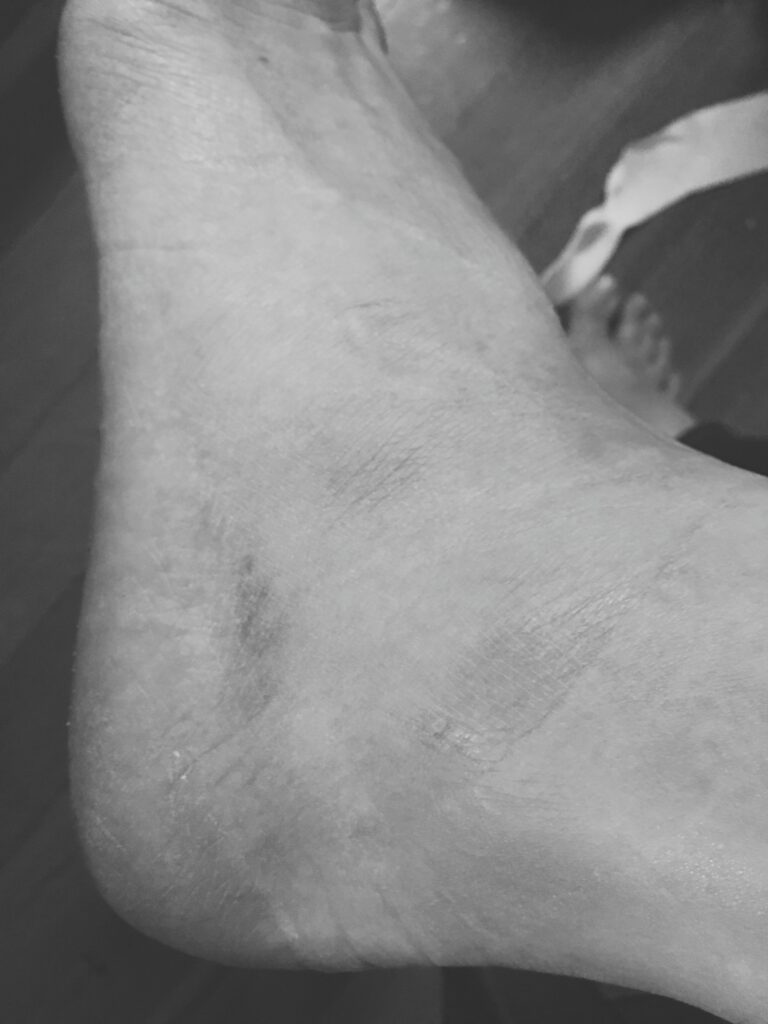
There is a photograph of my left hand, fingers bent back to touch my forearm — the casual, uncanny flexibility of hypermobile joints that have been hypervigilant for years, that have carried tension in their connective tissue the way other bodies carry it in their muscles, that have been responding to sustained threat with the only mechanism available to a nervous system that cannot locate the exit. My neck brace against bare skin. My knee brace, worn and familiar, the velcro softened from use. A printout showing an A1C that climbed, year by year, through the elementary school years, through the secondary school transition, through the meetings and the complaints and the stress leave — a number that tells a story the medical system is not organised to hear, because the story requires naming the school district as an etiological agent. That would be crazy.
This section is that photograph in prose. It is the body as record.



The body that was already there
I am autistic. I have ADHD. I have hypermobility syndrome, and a metabolic profile that requires careful management and responds badly to sustained physiological stress. I was late-identified — diagnosed at 36, after my children were already navigating a school system that was simultaneously failing to identify them and failing to accommodate the disability it had not yet named. By the time I understood the architecture of my own nervous system, I had already spent years inside an adversarial institutional relationship that was calibrated to produce the worst possible conditions for a body like mine.
This is the first thing to name, because it is the thing the caregiver burden literature almost universally fails to name: I did not become vulnerable because I was advocating. I was advocating inside a body that was already managing a complex load — neurological, metabolic, connective tissue, trauma history — and the advocacy added a sustained, unrelenting demand to that load without any corresponding reduction elsewhere.
The institution knew this. I had disclosed it, in writing, repeatedly, across years of correspondence with schools, district staff, and complaint bodies. The disclosure triggered no adjustment in how the process was designed, no reduction in what was required of me, no acknowledgment that the standard advocacy pathway — the meetings, the documentation, the complaint timelines — was not a neutral process that I happened to find stressful, but a process whose demands were, for a body like mine, operating as a form of cumulative injury.
Puar’s debility framework is not abstract here. It is the difference between my A1C in 2017 and my A1C in 2023. It is measurable. It is dated. It corresponds, with the precision of a clinical timeline, to the years of sustained institutional conflict that my medical record does not mention because no one thought to ask, and because the intake form does not have a field for school district.
Hypervigilance as occupational exposure
The neurological literature on chronic hypervigilance is well established. Sustained threat response — the kind produced by environments that are unpredictably hostile, that require constant monitoring for signs of danger, that punish relaxation with renewed harm — produces measurable physiological effects: elevated cortisol, disrupted sleep architecture, suppressed immune function, accelerated inflammatory processes, metabolic dysregulation. These are not the consequences of stress in the colloquial sense. They are the consequences of a nervous system that has been running its threat-detection apparatus at high capacity for an extended period without adequate recovery.
For autistic people, and for people with ADHD, this process has specific features. The autistic nervous system is already running higher baseline sensory and social processing loads than allistic nervous systems; the additional load of sustained institutional conflict does not simply add to an existing capacity, it compounds against an existing deficit. For those of us with hyperphantasia — vivid, involuntary mental imagery — the replaying of meeting exchanges, the anticipatory rehearsal of the next confrontation, the intrusive recall of the moment the VP looked at the document and chose not to read it — these are not metaphorical cognitive burdens. They are physiologically taxing events, experienced with the full sensory and emotional intensity of the original, occurring repeatedly, outside voluntary control, at two in the morning when the children are finally asleep and the body is trying to recover.
The hypermobile body under sustained load
Ehlers-Danlos syndrome is not simply a matter of flexible joints. It is a systemic connective tissue condition that affects the structural integrity of every joint in the body, produces chronic pain through joint instability and the muscular hypertonicity that develops to compensate for it, and is profoundly sensitive to stress — both physical and psychological. The connective tissue of hypermobile bodies is already working harder than average to maintain structural integrity; sustained psychological stress, which produces muscular tension and postural bracing as part of the threat response, increases that load significantly.
I wear a knee brace. I wear a neck brace. The mundane infrastructure of a body managing its own instability — the daily equipment of someone whose connective tissue has been asked to absorb, over years, the physical manifestation of what the school system required.
The relationship between psychological stress and hypermobility symptom severity is documented in the clinical literature, though it remains underrecognised in primary care. What is less documented is the specific contribution of sustained advocacy-related stress to hypermobility deterioration in parent advocates. I am naming it here because my body is the evidence and I am the researcher.
The neck brace became necessary during the years of heaviest impact. The knee instability worsened during the period of the formal complaint processes. These correlations are not proof of causation in the legal sense — though the constructive knowledge argument developed in section 5 will address what the legal standard actually requires. They are proof in the epistemic sense: the sense in which a body that has been carefully observed by the person living in it, over many years, constitutes a form of knowledge that the institution cannot simply dismiss as anecdotal.
Elaine Scarry argued that pain’s resistance to language is a political condition. The hypermobile body that cannot be seen to be injured — that does not produce the visible, dramatic evidence that institutional processes are organised to respond to — is subject to a specific form of that political condition. The pain is real. The deterioration is real. The causal relationship between sustained institutional conflict and worsening physical symptoms is real. The system’s inability to recognise it as harm does not make it less harmful; it makes the system more culpable, because the inability is structural rather than accidental.
The metabolic record
My A1C climbed across the years of heaviest advocacy. This is not a surprising finding in the clinical literature — the relationship between chronic stress and metabolic dysregulation is well established, with cortisol’s role in glucose regulation making metabolic markers a sensitive indicator of sustained physiological stress load. For someone with my metabolic profile, managing blood sugar carefully and supplementing deliberately, the deterioration represents not a failure of self-management but a burden that exceeded the capacity of careful management to absorb.
I take berberine, bitter melon, fenugreek, DMG, and countless other supplements. I maintain high fibre intake. I make my own fermented vegetables. I have been managing this metabolic profile with the same systematic, evidence-informed attention I bring to everything I do — because I am autistic, because I have always researched my own health.
The A1C climbed anyway. Because there is a ceiling on what individual self-management can absorb when the structural load exceeds the structural capacity. Because you can eat well and supplement carefully and still have a body that is metabolically responding to years of institutional conflict, years of sleep disruption, years of threat response, years of carrying the full cognitive and emotional weight of two children’s educational crises in a three-hour functional window while simultaneously performing the composure the institution required as the price of access.
This is Puar’s debility made legible through a number on a page. The number does not know it was produced by a school district. But I do. And the disclosure I made to that school district, in writing, documenting my metabolic vulnerability among the constellation of factors that made the standard advocacy process disproportionately harmful to me — that disclosure is also on a page. Both pages exist. The relationship between them is the argument of this section.
Stress leave and the functional capacity window
In the spring of 2026 I took stress leave. The stress leave was not precipitated by a single event. It was the predictable endpoint of a sustained period of operating beyond functional capacity — the body’s final refusal to continue absorbing what the system required while maintaining the performance of adequate functioning.
The stress leave was the body refusing the fiction that these costs were not being paid. It was, in the language of Puar, the debilitation becoming visible — crossing the threshold from the managed, invisible attrition of everyday function into the legible, documentable category of clinical incapacity. It was the body finally telling the truth loudly enough to be classified.
Weeks in bed did not feel like a holiday. They felt like a deeper recognition of the level of exhaustion my body had accumulated — the depth of the debt finally becoming legible when the performance of functioning was no longer possible.
My spirits did mend somewhat. My sense of humour returned, drier and more prevalent than it had been in years, which I understood as a sign of life.
My body continued its downward spiral. The two tracks ran separately — the self still sardonic, still capable of finding the absurdity in things; the body keeping a different account entirely.
I am forced to reduce my hours to return to adjust to the new functional window my body dictates.
The double exposure: advocating for children while managing your own
There is a dimension of this harm that the caregiver burden literature has not named, because the caregiver burden literature has not looked for it: the specific experience of being an autistic, ADHD parent with hypermobility and metabolic vulnerability, advocating for autistic, ADHD children with hypermobility, inside a school system that is simultaneously failing to accommodate your children and failing to adjust its process for you.
The double exposure is not additive. It is not that you carry the load of your own disability plus the load of your children’s. It is that the two loads are structurally entangled — that understanding your children’s experience requires understanding your own, that the same system that is producing debility in your children’s bodies is producing it in yours, that the same institutional processes that refuse to accommodate their needs are refusing to accommodate yours, and that the clarity this gives you — the embodied, cellular understanding of what is being done to them because you recognise it from inside your own nervous system — is precisely the clarity the institution will work hardest to discredit.
I am autistic. My children are autistic. I was not identified formally until I was 49; they were identified earlier, with my help, because I recognised what I was seeing. The late identification means I navigated my own education, my own early career, my own relationships without accommodation or support — masking with the thoroughness of someone who did not know they were masking, building the compensatory structures that would eventually become both my professional competence and my vulnerability. I came to advocacy already carrying that history in my nervous system. Already carrying the specific somatic legacy of years of unaccommodated neurodivergent existence in systems designed for other bodies.
The school system met that body with the same response it offered my children: processes that required more than was sustainable, timelines that ignored the evidence of harm, disclosures that were received without adjustment, and the consistent implicit message that the gap between what was needed and what was offered was a personal problem rather than an institutional failure.
My children’s debilitation and my own are not separate phenomena. They are the same system acting on the same family, across two generations, with the same combination of structural indifference and institutional self-protection. The photograph of my hypermobile hand and the photograph of my son in bed are the same photograph. They are the record of what it costs when an institution decides, at the level of policy and funding and accountability design, that some bodies are acceptable losses.
What the body knows
Elaine Scarry wrote that when pain at last finds a voice, it begins to tell a story. This section is that story.
The knee brace. The neck brace. The A1C printout. The stress leave documentation. The applications. The three-hour functional window. The disclosed vulnerabilities that triggered no adjustment. The hypermobility that worsened, measurably, through the years of sustained institutional conflict.
Section 5 will address what that knowledge obligates, legally and ethically, those institutions to do. But the legal argument rests on this foundation: the body is the evidence. The body has been kept as carefully as the email archive, the meeting notes, the FOI disclosures, the complaint files. The body has not forgotten what the institution would prefer to classify as a personal circumstance.
The body is the ledger.
Section 5: duty of care and the law
There is a principle in Canadian tort law called the thin skull rule. It holds that a wrongdoer is liable for the full extent of harm caused to a plaintiff, even if that harm is greater than would have been suffered by an average person — even if the plaintiff’s vulnerability was unknown to the defendant at the time of the wrong. You take your victim as you find them. If the person you harm happens to have a pre-existing condition that makes the harm worse than you anticipated, that is your liability, not their misfortune.
Now consider what happens when the vulnerability is not unknown. When it has been disclosed, in writing, repeatedly, across years of formal correspondence. When the institution received the disclosure, filed it, acknowledged it, and continued with the conduct that was producing the harm. When the thin skull was not merely present but documented — flagged, named, described in the specific clinical and functional language that accommodation frameworks require — and the institution chose, with full constructive knowledge of what that skull contained, to keep hitting it.
The thin skull rule was designed for the case where the defendant did not know. What we are describing is the case where they did.
The architecture of the legal obligation
Canadian human rights law does not require institutions to accommodate disabilities they are unaware of. The Ontario Human Rights Commission’s policy on disability states this plainly: the duty to accommodate arises for needs that are known or ought to be known. Ignorance, where genuine, provides a partial defence. Where ignorance is not genuine — where the institution has been told, clearly and repeatedly, what it is dealing with and what adjustments are required — the defence dissolves.
This framing is important because it shifts the moral and legal weight of the analysis from the question of whether harm occurred to the question of what the institution knew and when. The harm is established — in the medical record, the occupational documentation, the stress leave, , the deteriorating A1C, the worsening hypermobility, the fading functional window. The question section 5 addresses is the one that converts harm into accountability: what did the institution know, and what did that knowledge obligate it to do?
The answer, across multiple streams of Canadian law, is consistent and damning.
Disclosure as a legal trigger
I disclosed my disabilities to BC school institutions in writing, across multiple years, in correspondence that is preserved in full. I disclosed ADHD. I disclosed hypermobility syndrome. I disclosed the functional capacity limitations that made the standard advocacy and complaint process disproportionately burdensome. I disclosed, in specific terms, that the volume and pace of procedural requirements were producing measurable physiological harm.
Each disclosure was a legal trigger. Under the BC Human Rights Code, and under the analogous frameworks that govern how public institutions interact with disabled people in the context of their services, disclosure of a disability or functional limitation that is relevant to the service relationship — even where that service relationship is an adversarial complaint process rather than an employment relationship — activates obligations. The institution cannot continue to design and administer a process as though the disclosure was not made.
This principle has been developed most extensively in the employment context, where it is well established that an employer who receives disclosure of a disability acquires an obligation to inquire further into what accommodation might be required, and that failure to inquire before taking adverse action constitutes discrimination. The BC Human Rights Tribunal in Gardiner v Ministry of the Attorney General articulated the standard clearly: a respondent has a duty to inquire further where it has reason to believe there is an adverse effect of a medical condition on a person’s ability to function, prior to taking any action that would adversely impact them.
The language is employment-specific in the case law, but the principle is not. It is grounded in the foundational purpose of human rights legislation — to prevent the perpetuation of disadvantage by requiring those with power over processes to adjust those processes when they know, or ought to know, that the standard design is producing disproportionate harm to a person with a disability. That purpose applies with equal, and arguably greater, force in the context of public institution complaint processes, where the power asymmetry is more extreme, the stakes are higher, and the person navigating the process has no equivalent institutional resources to draw on.
The duty to inquire
The duty to accommodate does not require the disabled person to arrive with a complete accommodation plan. It requires the institution, upon receiving disclosure of a disability, to engage in a collaborative process of determining what adjustment is needed. Where the institution has reason to suspect that a medical condition is affecting a person’s ability to navigate the process — and where explicit written disclosure has been made, that reason is not in question — the institution’s failure to initiate that inquiry is itself discriminatory.
In Mackenzie v Jace Holdings, the Human Rights Tribunal of Ontario articulated this as the duty to inquire: the failure to make inquiries regarding a person’s health before taking steps that adversely affect them, where the respondent has reason to suspect a medical condition may be relevant, has been found to constitute discrimination. The tribunal’s reasoning is straightforward — if you know enough to have reason for suspicion, you know enough to have an obligation to ask. Silence in the face of disclosed vulnerability is not neutrality. It is a choice.
The school institutions I dealt with received my disclosures. They did not inquire further. They did not offer process adjustments. They explicitly denied accommodation requests.
This is not a borderline case. The disclosure was explicit, the institutional knowledge was complete, and the conduct continued unchanged. The question of whether a duty was owed is settled by the disclosure. The question of whether it was breached is settled by what happened next.
Social determinants of health and the elevated standard
Canadian equality law has increasingly recognised that social determinants of health — poverty, disability, single parenthood, racialisation, caregiver status — are not merely background context for individual health outcomes but legally relevant factors that affect the standard of care institutions owe. The Charter’s section 15 equality guarantee was understood, at its adoption, to impose positive responsibilities on governments to identify and address socio-economic disadvantage through affirmative measures — not merely to refrain from overt discrimination, but to adjust their conduct in recognition of the ways that structural disadvantage compounds the impact of standard institutional processes.
I am a single parent. I am autistic and ADHD with hypermobility and documented metabolic vulnerability. I was, during the years of heaviest advocacy, managing a household, two children in crisis, and a professional career within a diminishing functional window. Each of these factors is, individually, a social determinant of health that the literature identifies as elevating institutional obligation. Together, they constitute a profile of vulnerability that was disclosed to the institutions involved and that should have triggered not merely procedural adjustment but a fundamental rethinking of what an accessible complaint process would need to look like for a family like mine.
It did not trigger that rethinking. The process proceeded on its standard terms, at its standard pace, with its standard documentation requirements and its standard indifference to the cumulative load it was placing on a body that had told it, in writing, exactly what that load was producing.
The BC Ministry of Health’s 2025 Social Determinants of Health value set enumerates the factors that health systems are now required to collect and consider — socio-economic status, housing insecurity, disability, family structure. These are not rhetorical commitments. They are data standards with policy implications. The education system, which interacts with families at the precise intersection of most of these determinants, has not yet been required to operationalise them in the design of its complaint and advocacy processes. That gap is not accidental, and it is not sustainable.
Constructive harm: the gap between knowledge and action
Canadian law recognises constructive harm — harm that results not from a single discrete act but from the cumulative effect of an institution’s choices, made with knowledge of their likely impact. The institution that knows a person is vulnerable, knows its process is producing harm, and continues that process without adjustment is not merely negligent. It is, in the legal sense that matters for accountability, responsible for the harm its choices produce.
The gap between my disclosed vulnerability and the institutional response to it is not a gap that requires inference. It is documented in the correspondence — each disclosure on one side, each non-adjusted procedural requirement on the other, the worsening health markers in between. The causal chain is not circumstantial. It is sequential, specific, and preserved in writing.
This is the legal argument at its most concentrated: the institution knew. The institution had a duty, triggered by that knowledge, to adjust. The institution did not adjust. The harm that the adjustment would have prevented occurred, and is documented. The legal question is not whether harm occurred but whether the failure to prevent it, after knowledge was acquired, constitutes the kind of breach for which remedy is available.
Under Canadian human rights law, the answer is yes. Under the duty to inquire doctrine, the answer is yes. Under the thin skull rule’s extension to cases of known vulnerability, the answer is yes. Under the Moore mandatory support framework, applied analogically to the parent advocate’s access to complaint processes, the answer is yes.
The institution knew. It continued. The body kept the record.
Section 6: Who bears this harm — the demographic signature of institutional debilitation
The harm described in this paper is not randomly distributed. It clusters. It concentrates. It lands with measurably greater force on specific bodies, in specific configurations of vulnerability — a consistency that cannot be explained by individual circumstance and can only be understood as the statistical signature of a system organised, whether by design or by indifference, to extract the most from those who can least afford to give it.
Mothers
The gendered distribution of school advocacy labour is visible in every IEP meeting room in BC, in every complaint file, in every FOI request submitted by a parent: the person doing the work is, with overwhelming consistency, the mother. The unpaid labour of navigating institutional systems on behalf of children — the scheduling, the correspondence, the documentation, the emotional processing — is distributed along the same gendered lines as all caregiving labour. The assignment is gendered. The cost is gendered. The harm is gendered.
The credibility gap follows the same lines. A man with a trembling voice will mobilise a school ten times faster than a woman who has spent months writing clear, accurate reports about her child’s exclusion. The tone policing described in section 3 is specifically gendered in its application: the mother who departs from the required register of measured composure is unstable; the father who departs from it is passionate. Maternal rage — the embodied response to sustained moral injury — is the emotion the system is most specifically organised to suppress, because it is the emotion that most clearly names what is happening.
Neurodivergent parents advocating for neurodivergent children
Given the strong heritability of autism and ADHD, the majority of parents advocating most intensively for autistic and ADHD children are themselves autistic or ADHD — identified or not, accommodated or not. The complaint process was designed for a neurotypical adult with standard executive function, standard working memory, and standard resilience to adversarial institutional engagement. It is inaccessible to many of the parents it most needs to serve — not through visible exclusion but through cumulative, debilitating friction.
I was identified with ADHD at 36 and autism at 49. My children were identified earlier, in part because I recognised what I was seeing. The years between their birth and my own identification were years of advocating without legal standing, without named accommodation rights, without understanding the full neurological cost of what the process was extracting. The institution benefited from that gap.
Single parents and lower-income families
Single parents carry a load with no structural equivalent in the two-parent household. Documentation, complaint processes, FOI requests, legal research, emotional processing — all of it falls on one person who is also solely responsible for the household’s financial stability and the daily care of children in crisis. The financial dimension is not peripheral: school advocacy pursued at the level required to produce accountability — not merely manage harm — is expensive in time, professional cost, legal consultation, and psychological support. Two-parent households with two incomes can absorb some of these costs. Single parents with disabilities affecting earning capacity often cannot.
The exit option — private school, independent facilitator, lawyer retained from the outset — is available only to families with resources. For those without, the public complaint process is the only accountability mechanism available, and it is the mechanism most reliably exhausted by those with the least capacity to sustain it.
Families navigating institutional triangulation
The school’s systematic alignment with the more compliant co-parent against the more accurate one falls disproportionately on parents already managing contested custody alongside school advocacy. The institution defaults to the account that requires less of it. Accuracy is demanding; compliance is comfortable. The parent who documents carefully, remembers precisely, and refuses euphemism is classified as difficult. The parent who agrees easily and asks for nothing specific feels like a partner.
This dynamic means every disclosure, every documented harm, every carefully constructed complaint arrives into a context where the institution has already aligned itself with a counter-narrative — and the truth, however precisely documented, competes on unequal terms with the story that asks less of everyone.
The intersectional concentration
These categories overlap and compound. The body bearing the most concentrated form of this harm is the body described throughout this paper: a late-identified autistic, ADHD woman with hypermobility and metabolic vulnerability, parenting neurodivergent children alone, navigating a complaint process designed for a different kind of body, against an institution that received her disclosures and continued, within a co-parenting context that handed the institution its preferred counter-narrative.
This is not a rare configuration. It is a predictable one — produced by the heritability of neurodivergence, the gendered distribution of caregiving labour, the relationship between disability and poverty, and the patterns of family breakdown under sustained institutional stress. The system produces it, over and over, across BC’s sixty school districts, and classifies it as a personal situation rather than a structural outcome.
The pattern is the argument.
Section 7: iatrogenic framing vs caregiver burden
There is a reason the existing literature calls this caregiver burden.
Burden is a word that belongs to the person carrying it. It names a weight, and it locates that weight in the body of the one who bears it, and it implies — without ever quite saying — that the weight is inherent to the situation rather than produced by choices someone made about the situation.
Caregiver burden produces a specific set of implications: that the appropriate response is support for the caregiver, wellness programs, respite care, psychological services, better self-care practices, more resilient coping strategies. It produces a literature organised around individual intervention. It produces a policy conversation organised around what can be offered to the person who is suffering, not around what the institution must stop doing to produce the suffering. It produces a framework in which the solution is always located in the individual — in their capacity to manage, to cope, to sustain — and in which the institution is a background condition rather than a causal agent.
Iatrogenic harm produces different implications entirely.
From background condition to causal agent
The first and most fundamental thing that iatrogenic framing does is name the institution as the agent of harm rather than the context in which harm happens to occur.
In the caregiver burden literature, the school system appears, if it appears at all, as one among many stressors — a source of frustration, a site of conflict, an additional demand on an already stretched family. The framework is additive: the child’s needs are complex, the family’s resources are limited, and the school system adds further demands to an already difficult situation. The school is part of the load, not the source of the debilitation.
Iatrogenic framing reverses this. It positions the institution not as a background stressor but as the primary etiological agent — the entity whose specific choices, processes, and conduct produced the harm that is being documented. The child’s disability did not debilitate the parent. The institution’s response to the child’s disability — its specific, reproducible, structurally predictable choices about how to manage, defer, and resist the accommodation that would have prevented the harm — debilitated the parent. The distinction is causal, and it is the distinction on which the entire accountability argument rests.
This matters in the courtroom. A claimant seeking remedy for caregiver burden must explain why the institution owes them anything — because burden, in its standard framing, is not an institutional product. A claimant seeking remedy for iatrogenic harm is operating within a framework in which the institution’s causal role is the premise, not the conclusion to be established. The naming does legal work before the first argument is made.
From individual pathology to structural pattern
The second thing iatrogenic framing does is shift the unit of analysis from the individual to the structure.
Caregiver burden, as a category, describes individuals. It describes this parent’s depression, this parent’s burnout, this parent’s A1C, this parent’s stress leave. It is amenable to individual case studies and personal narratives, and it produces knowledge about particular people in particular situations. What it cannot easily produce — because the framework is not built for it — is knowledge about the pattern that connects those individuals: the structural arrangement that reliably produces the same outcomes, in the same demographic concentrations, across different families, different school districts, different years.
Iatrogenic harm, as a category, describes systems. It asks not what happened to this person but what this institution does — reproducibly, predictably, across populations — and what that doing costs the people subjected to it. The question is not why this parent burned out but why parents who engage with this specific type of institutional process burn out at this rate, in this demographic distribution, with this specific constellation of physiological markers.
That is a question with a structural answer. And structural answers produce structural remedies — remedies that require institutional change rather than individual coping strategies, remedies that address the design of the process rather than the resilience of the person navigating it, remedies that are enforceable rather than aspirational.
Section 6 documented the demographic signature of this harm: the concentration in mothers, in neurodivergent parents, in single parents, in lower-income families, in families navigating institutional triangulation. That signature is not compatible with the caregiver burden framework, which would explain it as the natural consequence of the additional vulnerabilities those groups bring to an inherently demanding situation. It is compatible only with the iatrogenic framework, which explains it as the predictable output of processes designed — or functioning as if designed — to extract the most from those with the least capacity to resist extraction.
The pattern is the evidence that the harm is structural. The iatrogenic framing is what makes the pattern visible as evidence rather than as the accumulated tragedy of many individual families.
From personal resilience to institutional liability
The third thing iatrogenic framing does — and the thing that matters most for the remedial argument — is open the question of liability.
Caregiver burden forecloses liability almost completely. If the harm is understood as the weight a person carries in difficult circumstances, there is no obvious defendant. The child’s disability is not a defendant. The difficulty of the situation is not a defendant. The institution that managed the situation in ways that made it more difficult — that is a potential defendant, but only if the framework names the institution as a causal agent rather than a background condition. The caregiver burden framework does not name it that way. The iatrogenic framing does.
Liability requires causation, and causation requires an agent. The iatrogenic framing provides the agent — not abstractly, but specifically: this institution, through these mechanisms, with this knowledge, over this timeline, producing this documented harm in this body. Each element of that chain has been established in the preceding sections of this paper. The taxonomy in section 3 names the mechanisms. The physiology in section 4 names the harm and its temporal correspondence to the institutional conduct. The legal analysis in section 5 names the obligations the institution’s knowledge triggered and the breach that occurred when those obligations were not met. The demographic analysis in section 6 names the pattern that distinguishes structural harm from individual misfortune.
Together, they constitute an iatrogenic claim — a claim that the institution produced the harm, that it did so through identifiable mechanisms, that it had the knowledge that should have prevented it, and that it is therefore accountable for what its choices cost.
This is not a claim that caregiver burden analysis can support. It is only available within the iatrogenic framework — which is precisely why the framework matters, and precisely why the existing literature’s resistance to it is not merely an academic limitation but a political choice with real consequences for real families.
From coping intervention to systemic remedy
The fourth implication of the framing shift is the most practically consequential: it changes what remedy looks like.
Caregiver burden produces wellness-program solutions and personal mitigation costs. It produces respite care and psychological support and self-care resources and peer support groups and all the other individual-level interventions that are genuinely useful and genuinely insufficient, because they address the symptom while leaving the cause intact. They make it more possible to continue surviving the process without changing the process. They are, in the language of section 3’s taxonomy, the institutional equivalent of performative accessibility: gestures that absorb the force of the harm without producing the structural change that would prevent it.
Iatrogenic harm produces different remedies. It produces process redesign — the requirement that complaint and advocacy processes be made genuinely accessible to the disabled parents who disproportionately use them, beginning from the recognition that accessibility is not an add-on but a prerequisite. It produces legal aid parity — the recognition that a complaint process is not functionally accessible to families without the resources to sustain multi-year proceedings, and that the institution’s ability to benefit from that inaccessibility is itself a harm requiring remedy. It produces early resolution mechanisms — the recognition that the temporal dimension of the complaint process is itself an instrument of harm, and that justice delayed beyond the family’s capacity to pursue it is justice denied in the most operationally precise sense.
It produces, most fundamentally, institutional accountability — the requirement that the institution answer for what its choices produced, not merely that it offer support to those it harmed while those choices remain in place.
From individual testimony to evidentiary infrastructure
The fifth thing iatrogenic framing does is transform personal testimony into evidentiary infrastructure.
This matters particularly in the Human Rights Tribunal context, where the evidentiary requirements for establishing discrimination require connecting systemic harm to individual impact through a protected ground and a respondent. Caregiver burden testimony — however compelling, however precisely documented — is vulnerable to the institutional response that the harm, however real, is attributable to the complexity of the situation rather than to the institution’s specific conduct. The institution did not cause the child’s disability. The institution did not cause the difficulty of caring for a disabled child. The institution merely participated in a difficult situation, and whatever harm the parent experienced was the harm of the situation, not the harm of the institution’s response to it.
Iatrogenic framing closes that escape route. It positions the parent’s testimony not as the expression of individual suffering but as the documentation of a structural pattern — each instance of disclosed vulnerability met with continued conduct, each mechanism operating as described, each physiological marker corresponding to the timeline of institutional engagement rather than to the underlying disability that predated it. The testimony becomes, within the iatrogenic framework, a contribution to a pattern of evidence rather than an isolated account of personal hardship.
This is the transformation that makes the archive — seven hundred thousand words of contemporaneous documentation — into something more than the record of one family’s experience. It makes it evidence of how an institution operates. And evidence of how an institution operates is evidence the institution cannot simply dismiss as personal, as subjective, as the experience of one unusually persistent and unusually articulate parent who happened to find the process difficult.
The political stakes of naming
The caregiver burden framework allows an institution to express genuine concern for the wellbeing of families while continuing the harm. It allows the institution to fund a parent support group while maintaining the complaint process that produces the need for one. It allows the institution to acknowledge the difficulty of the situation while locating that difficulty in the disability rather than in the institutional response to the disability. It allows, in short, for the full performance of care without the substance of accountability.
The iatrogenic framework does not allow this. It requires the institution to answer a different question — not how can we support families who are struggling but what are we doing that is producing the struggle, and what are we going to do differently — and that question, once asked, does not have a comfortable answer. It has an accountable one.
This paper asks that question. It asks it with the full weight of the evidentiary record assembled in the preceding sections, with the theoretical apparatus that makes the pattern visible as structure rather than individual misfortune, with the legal framework that names the obligation the pattern activates, and with the demographic analysis that identifies the specific populations the institution has been organised, whether by design or by indifference, to exhaust.
What you call a thing determines what you are required to do about it. Call it burden, and you are required to offer support. Call it iatrogenic harm, and you are required to stop producing it, to compensate for what you produced, and to redesign the processes through which you produced it so that they cannot produce it again.
The families documented in this paper were not burdened. They were harmed — specifically, structurally, with full institutional knowledge, over documented timelines, through named mechanisms, in bodies that kept the record.
The record is here. The naming is complete. What remains is the accountability.
Section 8: closing
I return, at the end, to the photograph from Tofino.
The children are small, faces pink against the grey-green Pacific, leaning into the wind as if it were something to meet rather than something to survive. The image holds possibility in a precise sense: trajectories that were open, capacities already visible, a life moving outward.
What the photograph shows is a family before the narrowing began.
That narrowing has a shape. It appears in the withdrawal, the physiological collapse, the thinning of ordinary life. It appears in the body, in the record, in what no longer happens. It did not arrive all at once. It accumulated through decisions — small, procedural, defensible in isolation, and consistent in effect. Support not delivered. Timelines allowed to slip. Disclosures received and left without adjustment. Complaints processed without resolution. Complaint for containment’s sake.
The result is written across the same bodies the photograph once held in motion.
A child who no longer leaves his room. A parent whose metabolic record tracks the cost with clinical precision. A feed that no longer documents milestones because the conditions that made those milestones possible have been stripped away.
The photograph anchors the counterfactual without abstraction. It shows capacity, engagement, and direction. It shows what existed before the system intervened in the ways this paper has documented. The distance between that image and the present is the measure of what was foreclosed.
This is a question of structure.
The mechanisms named in this paper operate predictably. They produce the same outcomes across families, across districts, across years. The pattern holds. The distribution is not random. The harm follows the design.
So does the remedy.
Timelines that bind. Processes that resolve. Accommodation that begins at disclosure. Systems that measure outcome rather than appearance, and that are required to act on what they measure.
The photograph from Tofino does not ask to be restored. It establishes something more exacting than that.
Another path existed.