Many years ago, my kindergarten child Robin went onto an ice field during recess. Robin was seeking sensory input—the visual shimmer, the cracking sound, the tactile feedback their nervous system required. The school had told students to avoid the ice for safety reasons. Robin’s support worker redirected them repeatedly; Robin kept returning. Eventually the principal intervened and Robin left the ice.
The next day, the school closed the gravel field and basketball court to all students at lunch.
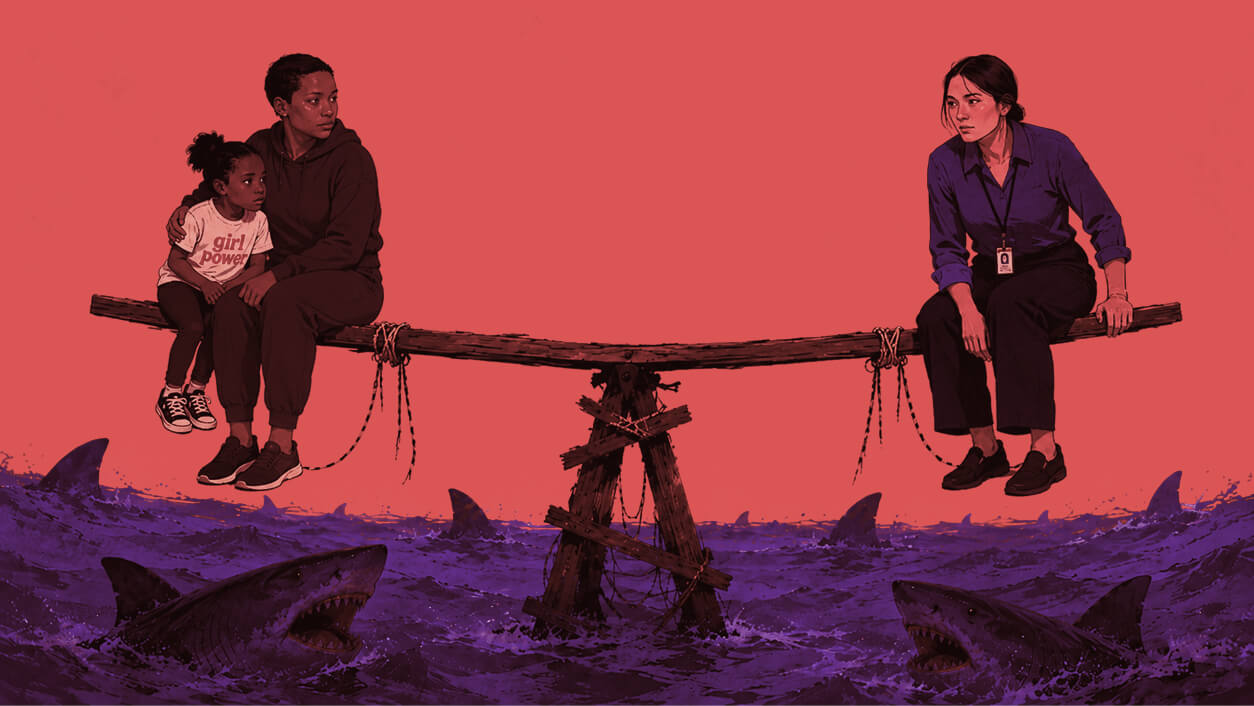
When I asked whether other children were being punished because of Robin, the principal reframed the decision as a safety measure. But functionally, this was collective punishment: a group sanction imposed in response to one child’s behaviour. Legal scholars J. Shahar Dillbary and Thomas J. Miceli describe collective punishment as a system that creates “sinners” and “scapegoats.” Robin became the identified rule-breaker. Other students lost access to playground space, creating peer pressure to monitor and resent Robin.
This incident only makes sense when placed in its broader context. The real “sinner” in British Columbia’s education system is not a disabled child—it is the province. Chronic underfunding, inadequate staffing, and refusal to resource inclusion properly create conditions where failure is inevitable. Disabled children absorb the blame for chaos, burnout, and scarcity that originate in provincial policy. Collective punishment doesn’t just manage behaviour; it converts funding failure into perceived behavioural failure, protecting austerity from political challenge.
-
Collective punishment: how schools displace guilt, erase harm, and preserve the collective
One of the things that was so traumatising about the collective punishment that was callously perpetrated against my daughter was the light and evasive tone of the principal. She said that the punishment had to be “swift.” I frequently wondered about the choice…
Designing systems where inclusion cannot work
British Columbia funds schools as if most students require minimal support, classrooms of 26 can be managed without adequate staffing, and buildings designed for neurotypical bodies serve everyone equally. Categorical funding for designated students exists, but it falls far short of what inclusion actually requires: sufficient staffing, regulation and sensory support, time for repair after crises, sustained specialist involvement, staff training with follow-through, and physical environments that do not actively dysregulate students.
Instead, schools operate with staffing ratios that make individual support impossible, Educational Assistant hours that cover only fragments of need, specialists who appear briefly and disappear, professional development reduced to one-off workshops, and buildings that overwhelm sensory systems. Behavioural frameworks emphasise compliance over communication.
This is not accidental. The province funds the system it values—one that works for students who fit standard design. Students who need accommodation are treated as costly exceptions rather than as a predictable part of any population. The gap between what inclusion requires and what the province funds forces schools into triage: some children get support, others are left to fail.
The province maintains this gap deliberately. Inclusion is framed as an aspiration constrained by “practical limits,” rather than as a legal obligation the province refuses to fund.
-

In genocide and the classroom: the routinising of distress
A meditation on how institutions train people to ignore suffering—how desensitisation, scarcity, and forced optimism erode empathy and make harm seem ordinary.
Collective punishment and performed failure
Within these constraints, schools turn to collective punishment because it is cheap. As Dillbary and Miceli note, institutions favour group sanctions when they impose little cost on enforcers. Closing a playground requires no extra staff, no planning, no accommodation—yet it deters behaviour by making one child’s actions visible to others.
After the ice incident, the school could have increased supervision, provided a safe sensory alternative, or accommodated Robin’s need in a controlled way. All of these required labour. Closing shared spaces did not.
Schools also perform a version of “inclusion” that is structured to fail. Disabled children remain in mainstream settings without the regulation support, repair, or reintegration that would allow success. Dysregulation continues. Incidents escalate. Documentation accumulates.
When Robin had meltdowns, including biting other students, the school recorded the incidents but provided limited regulation work, relational repair, and reflective processing. Robin was returned to class without support, ensuring future incidents were likely.
This served institutional needs: Robin appeared persistently dangerous; inclusion appeared ineffective; collective punishment seemed justified; and our family eventually removed Robin to provide the support the school would not. Providing real support would have required sustained adult presence and relational work the funding model makes impossible. Allowing failure cost the school nothing.
Engineering parent blame
Other parents did not see funding formulas, staffing shortages, or refused support. They saw their children lose recess, endure disruptions, hear about biting incidents, and watch teachers burn out. The message was simple: this child is the problem.
What parents experienced:
- Lost privileges because of a disabled child
- Classroom disruption attributed to inclusion
- Apparent lack of consequences for serious behaviour
- Scarce resources consumed by one student
What they did not see:
- Funding levels that make support impossible
- Decisions to withhold regulation and repair
- Environmental design that provoked crisis
- Collective punishment chosen for convenience
This produces two politically useful outcomes.
First, mainstream parents prefer segregation—separate programmes, shortened days, removals—framed as safety, not discrimination. Meanwhile more and more parents pull their kids from school because the environment is impossible, meaning their children are isolated.
Second, parents accept scarcity as inevitable rather than as policy choice. Resource limits appear natural, not deliberate. No coalition forms to demand adequate funding.
In both cases, the province avoids pressure to change.
The same logic everywhere
The mechanism repeats across contexts. During COVID-19, schools refused to install HEPA filters despite clear evidence they reduced airborne transmission. The cost was modest. The benefit was safety for immunocompromised children. But providing clean air required spending money. Refusing it appeared costless because harm fell on marginalised families.
Again, those children became scapegoats—portrayed as unreasonable, demanding special treatment, or expecting schools to prioritise them over others. Inclusion was framed as incompatible with normal operation, rather than revealing a refusal to fund basic protections.
The pattern is consistent: deny baseline accommodations, allow visible failure, point to failure as proof inclusion cannot work, and maintain austerity.
What this system accomplishes
Underfunding creates impossible conditions. Schools cope by using collective punishment and withholding support. Disabled children remain visibly dysregulated. Non-disabled children experience costs. Parents blame inclusion. The province faces no political threat.
This is not accidental. It is a self-reinforcing system that converts provincial policy choices into disabled children’s perceived failures.
Robin never returned to Vancouver School Board schools. We absorbed the private cost of public failure.
Seven years later, across British Columbia, the pattern is clear: collective punishment at the school level sustains austerity at the provincial level. Disabled children are sacrificed to preserve a funding model that cannot support inclusion.
Breaking this cycle requires naming the mechanism. The chaos parents see is not caused by disabled children. It is caused by refused investment. Adequate funding would enable staffing, regulation support, repair work, safe environments, and genuine inclusion.
What the province currently funds ensures none of this happens—and collective punishment ensures parents blame the wrong target.
-

Engineered famine in public education
In British Columbia schools today, we are not facing a behaviour crisis—we are facing a famine of care. This essay weaves together personal memory, systemic critique, and deep empathy for teachers and families alike to ask why our schools are starving the very…