
Legal and ethical
Includes the laws, policies, complaint routes, records, oversight bodies, and accountability tools families use to challenge exclusion, discrimination, delay, denial of accommodation, and procedural harm in schools.
-
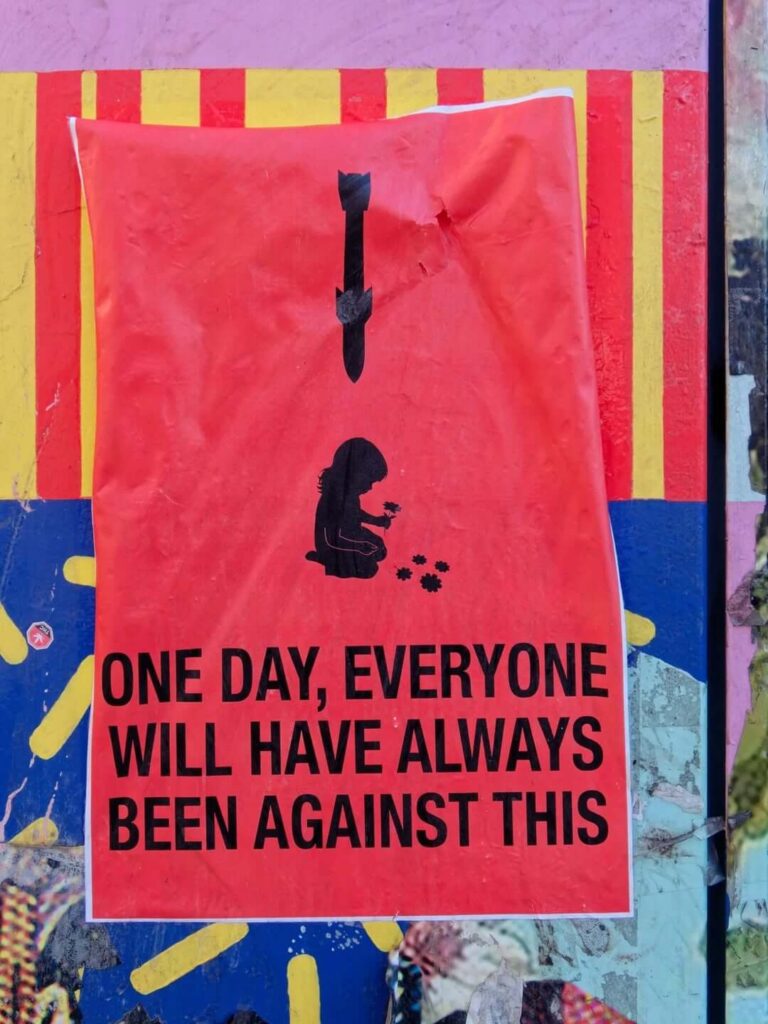
One day, everyone will have always been against this
There is a piece of street art circulating depicting a small child crouched beneath a descending bomb, gathering flowers from the ground, and beneath her the words: one day, everyone will have always been against this. That phrase — “one day, everyone will have always been against this” — comes from Omar El Akkad, reflecting…
-

When the complaint becomes the problem
The Canary Collective has published a piece Risk Assessment and Liability Management: The Hidden Function of Complaints that describes the process by which a parent raising legitimate concerns about their child’s education is transformed, through careful documentation and strategic delay, into a risk to be managed rather than a voice to be heard. The article…
-

Masking and Human Rights law in BC
Autistic students (especially girls) often hide (“mask”) their natural behaviours to avoid peer conflict and “fit in” at school. When educators implicitly or explicitly demand this masking – for example by discouraging stimming or forcing conformity – it can amount to a form of discrimination and harm under BC and Canadian law. This article examines…
-

The masking tax: how autistic girls absorb bullying invisibly in BC schools
Autistic girls in B.C. schools often develop sophisticated masking or camouflaging strategies to hide their autism in order to fit in and avoid bullying. In the short term this can make them appear “fine” – leading teachers and administrators to assume no support is needed – but the “masking tax” is high. Decades of invisible stress and exclusion build up as girls…
-
Exclusion tracker: what 6,783 reports are telling us
The numbers arrived quietly, published in an interim report from the National Exclusion Tracker — five months of data collected since the tracker expanded from a BC-only tool to a national one, capturing the experiences of families across eleven provinces and territories. 6,783 reported incidents of exclusion from K–12 education since September. 68% of them…
-

The cost of defending scarcity: moral injury and the exhaustion economy
The BC education system spends extraordinary resources defending scarcity while positioning that defence as fiscal responsibility, generating an exhaustion infrastructure that operates across every population the system touches—teachers, families, disabled children, administrators, support staff—all labouring to maintain stories that protect individual dignity within conditions designed to make moral action impossible. A recent analysis on Fund…
-

Meltdown monster: how exclusion makes bullying worse
I often think back to the school principal telling me that when kids see my son, they don’t see an autistic child, they just see a child being mean. When a disabled child melts down at school—after sensory overload, social stress, academic pressure, and chronic misattunement—schools rarely ask what led up to the crisis. Instead,…
-

Advocacy is too hard and schools expect too much
The BC Ministry of Education directs families to file complaints through their school district’s K12 system when schools violate policy, deny accommodations, or harm disabled children through exclusionary discipline. The process presents itself as accessible redress, a pathway families can navigate while managing the daily crisis of a child being room cleared, partially scheduled, or…
-

What 8 years of advocacy took from our family
I advocate because I love my children and I want them to be well. Because I know the accommodations they require are entirely tenable, requiring only modest shifts in how adults think and respond. Because it is unbearable to watch them be slowly debilitated by a system that insists their needs are excessive and their…
-

When improvement tolerates death: why schools must stop the line
Education systems insist they are engaged in continuous improvement. They invoke cycles, frameworks, data dashboards, and action plans to demonstrate seriousness and care. But children are killing themselves in every district, every year. Disabled children are being excluded, isolated, placed in hallways, sent home early, or left to deteriorate while plans are written. The question…
-

The business process trap
I’m a business analyst by trade, so I naturally wanted to understand how things work in schools, but resist the temptation to let schools draw you in!!! School districts speak a language designed to obscure accountability, using administrative complexity as armour against obligation, converting urgent need into bureaucratic procedure, and replacing immediate legal duty with…
-

Newfoundland and Labrador announces $11,000 investment in inclusive education
The provincial government issued a press release celebrating its distribution of $11,000 across eleven schools—$1,000 per institution—framed as demonstrable commitment to safe, caring, and inclusive learning environments. Yes, you read that right: a press release for 11k. The arithmetic speaks plainly: this measly sum, distributed across an entire province’s school system, positioned as evidence of…
-

Ministry regulations on physical restraint and seclusion in BC schools
Physical restraint and seclusion are permitted in British Columbia schools under the Ministry of Education and Childcare guidelines—despite being widely described as last-resort safety measures. When schools restrain or isolate disabled children, districts often cite the Provincial Guidelines on Physical Restraint and Seclusion in School Settings (2015) to claim compliance. Parents are told the intervention…
-

On subjectivity, vicarious belonging, and institutional violence
Winter light, girls singing, a boy listening from the front seat. A mother tries to witness without interpreting what nine months of isolation cost.
-

How BC education policy discourse positions institutional refusal as neutral fact
This is a methodological critique examining how dominant policy analysis systematically erases the institutional practices that produce educational exclusion while appearing rigorous, neutral, and evidence-based. Understanding this analytical apparatus matters because it shapes what counts as legitimate evidence in meetings, what research administrators cite to justify program decisions, and what policy recommendations achieve political traction.…
-

Tara Carman tracks absences district by district
CBC’s Tara Carman released another investigation this week, this one examining absence patterns across British Columbia’s largest school districts, finding that excused absences have tripled in Vancouver secondary schools between October 2018 and October 2025, that chronic absence rates have quadrupled in Burnaby, that the numbers climb steadily across Central Okanagan and Surrey despite marginal…
-
Teacher employment negotiations reach impasse
BC teachers reached an impasse with their employer this week after the province refused to fund improvements to classroom conditions, offering wage increases while withholding the supports that would allow teachers to meet student needs. The union points to counsellor ratios averaging one per 693 students against a North American standard of one per 250,…
-
Where Surrey’s $6.3 million went
I recently reviewed the provincial budget tables and buried within Table 17 (2024/25 Amended Annual Budgeted Operating Expenditures of Program 1.10 Inclusive Education by Object) and Table 26 (2024/25 Actual Operating Expenses of Program 1.10 Inclusive Education by Object) of British Columbia’s 2024/25 operating budget documents lies evidence of what can only be described as…
-

Champlain Heights Annex School (VSB SD39): a neurodiversity-informed conduct critique
Champlain Heights Annex School’s Code of Conduct promises a safe, inclusive, equitable, welcoming, nurturing, and healthy school environment. The document aligns explicitly with Vancouver School Board’s District Student Code of Conduct (AP 350), affirms the BC Human Rights Code, and structures behavioural expectations through a three-level consequence framework extending from classroom redirection to formal suspension.…
-

Section 22 of BC’s Freedom of Information and Protection of Privacy Act
Public bodies in BC may only withhold information under FIPPA if a specific exception applies: Each redaction must cite the exact statutory section and explain how disclosure would cause the harm the exemption is meant to prevent, as detailed in Section 8 of FIPPA. This article was prepared for my own edification for advocacy actions I…