The Education and Childcare Estimate Notes 2025 reveal a province experiencing an enormous rise in disability designations while preparing the minister with polished assurances that gesture toward progress, equity, and commitment, and this dual presentation of crisis beneath a veneer of stability creates a document that tells two stories at once: one whispered in the margins of budget tables and policy footnotes, and another crafted for the bright surface of legislative debate.
A province experiencing a dramatic surge in disability designation
The ministry’s own numbers show a landscape shifting with historic speed, because between 2015–16 and 2024–25, the population of students in the Autism Spectrum Disorder category grew from 7,794 to 22,824, a rise of over 192%, while the overall student population increased by only 11.6%, and this gulf represents a profound demographic transformation that has reshaped classrooms, social dynamics, behavioural expectations, and the emotional labour parents carry each day as they try to keep their children afloat inside a system that never evolved at the pace their children’s needs required.
“Since 2015/16, there has been a 11.6% increase in the total number of students enrolled in public BC K-12 schools, but a 46.6% increase in the number of students with inclusive education designations. The number of students designated in the Autism Spectrum Disorder category has increased by over 192% (from 7,794 students to 22,824 students) during that same time.”
The Education and Childcare Estimate Notes 2025
The documents pair these numbers with celebratory language about doubling inclusive education funding since 2017, yet the growth in disability designation far exceeds the growth in funding, creating an arithmetic reality that shapes everything families experience—extended waitlists, cyclical behaviour plans, patchwork support, and classroom cultures shaped by scarcity rather than abundance—because a system that funds disability at a slower rate than disability expands creates a predictable pattern of rationing, triage, partial days, crisis teams, and burnout across every level of the institution.
“Our government has more than doubled inclusive education funding since 2017 and we are continuing to focus on provincial supports for K-12 students with disabilities or diverse abilities.”
The province recognises the explosive growth of disability-related need, yet continues to navigate it with a funding model and a set of conceptual tools inherited from an earlier era of lower complexity, lower prevalence, and lower public scrutiny.
A ministry aware of exclusion long before investigation
Alongside this rising disability prevalence, the same Estimates Notes display an equally clear awareness of systemic exclusion, because they reference the BCEDAccess exclusion tracker, the Family Support Institute’s assumption of that work, and the impending “child care exclusion tracker,” and these references confirm that the ministry has followed the data, the stories, the complaints, and the patterns for years.
The documents acknowledge shifting public concern, sustained advocacy pressure, and widespread alarm among families and disability organisations, and they prepare the minister with language emphasising partnership, alignment, and commitment, which sits beside internal recognition that the current funding model remains outdated, that policy revisions stalled for years, and that repeated attempts to update the Inclusive Education Policy faltered due to structural gaps that educators, families, and community partners repeatedly raised.
The notes directly reference the Ombudsperson’s investigation, with a projected completion date of January 2026, and this timeline shows that the province expected external scrutiny of exclusion while continuing to centre messages of progress in Estimates debate, a strategy that creates a dual reality: one constructed for public reassurance and one captured in briefing materials that quietly affirm the gravity of exclusion as a systemic pattern rather than an isolated sequence of district-level missteps.
-

The unseen wounds of advocacy: caregiver burnout, moral injury, and embodied grief
Caregiver burnout in BC schools reflects moral injury and systemic betrayal, as mothers fight exclusion and harm while advocating for disabled children.

Exclusion framed as a known phenomenon
The internal briefing positions exclusion as a recognised institutional reality, because it describes escalating concern, acknowledges multi-year tracking by community groups, and emphasises the ministry’s willingness to collaborate with the Ombudsperson, signalling that the ministry entered this investigation with full awareness of its significance, its scale, and its public visibility.
This presence of internal awareness undermines narratives offered to families at the school or district level—narratives that often frame exclusion as an unusual, a temporary measure, or a unique response to an individual child’s behaviour—because the ministry’s pages depict exclusion as a generalised, province-wide phenomenon that aligns with rising complexity, insufficient staffing, outdated policy, and funding structures that trail far behind demographic change.
Using disability prevalence to stabilise budgets
One of the most revealing lines in the Estimates Notes states that any financial savings from declining public-school enrolment will be reduced, even erased, by “growth in higher-cost student categories, especially inclusive education designations,” and this admission exposes a previously unspoken truth: disability prevalence shores up a funding model threatened by demographic shifts.
“ECC did not request additional Public School enrolment funding in Budget 2025 due to a forecasted student enrolment decline for the first time since 2015/16. However, any savings from reduced enrolment will be reduced by funding backstops in the K-12 model and are expected to be offset bv growth in higher-cost student categories, especially inclusive education designations.”
The Education and Childcare Estimate Notes 2025
The document indirectly acknowledges that the system depends on rising numbers of disabled children to maintain district funding, because the loss of typical students creates budget holes that are filled by supplements associated with inclusive education categories, and this exposes a structural dependence that families experience as moral burden and bureaucratic scrutiny, because the education of disabled children becomes a fiscal compensatory mechanism rather than a rights-based entitlement.
Surpluses, scarcity narratives, manufactured constraint
The same briefing notes that districts ended the last fiscal year with a cumulative surplus of $327 million, an increase over the previous year, and the ministry concludes that districts can absorb inflationary cost pressures, which sits in striking contrast to the stories families hear in classrooms, where scarcity is offered as explanation for partial attendance, EA shortages, and unmanageable caseloads.
“The increase in accumulated surplus, coupled with the conservative budgeting approach taken by school districts, indicates that districts can absorb the inflationary cost pressures.”
The Education and Childcare Estimate Notes 2025
This contradiction reveals a policy landscape where district-level scarcity is a rhetorical position rather than a financial inevitability, because the ministry’s own documents demonstrate the presence of significant reserves that coexist with widespread reliance on exclusion as an administrative solution to unmet need.
-
The goodwill ledger: how schools calculate inclusion allotments
Schools in British Columbia keep an invisible ledger—one that tracks not just budgets, but emotions, tone, and perceived worthiness. Families who ask too clearly, too often, or on behalf of more than one child are quickly marked as overdrawn. This essay continues the…

A funding model that prioritises legacy obligations while ignoring contemporary complexity
The Estimates Notes reveal that the Classroom Enhancement Fund consumes nearly $800 million a year, almost a tenth of the entire K–12 budget, because the restoration of class size and composition language required thousands of new teaching positions, extensive overhead, and millions in remedy costs, and this historic obligation now competes with the urgent and rising need for inclusive support.
The province funds this legacy requirement almost automatically, year after year, while offering no parallel mechanism for updating inclusive education funding in response to complexity, demographic change, or the emotional realities of disabled children whose needs far exceed the imaginative capacity of a decades-old formula oriented around categories rather than lived experience.
An absence of exclusion metrics inside a document obsessed with counting everything else
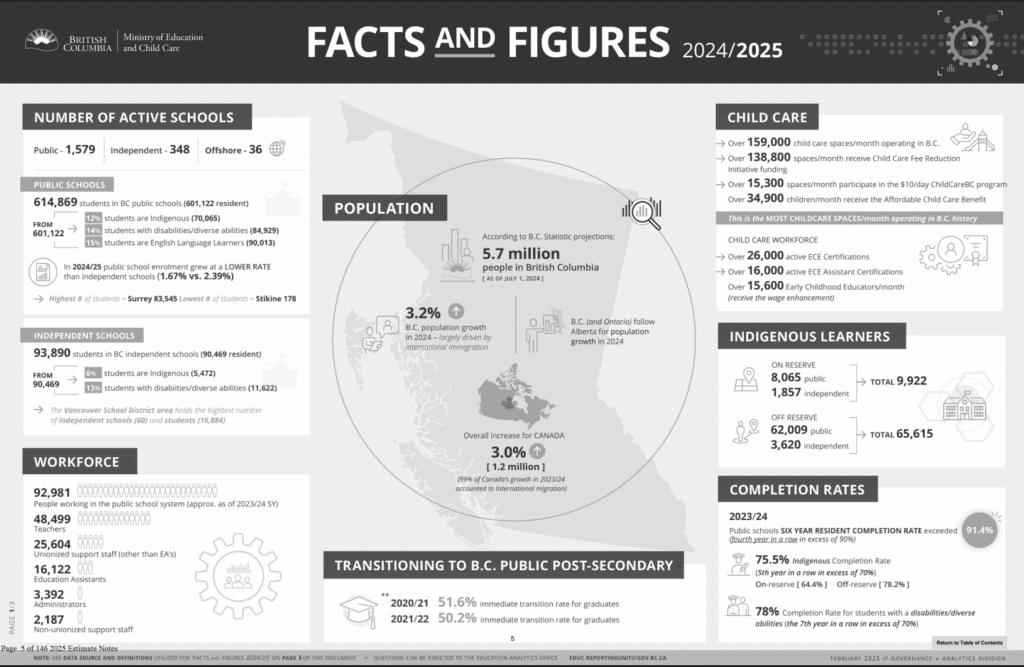
The Estimates Notes measure everything: school counts, staff counts, ECE qualifications, independent-school categories, completion rates, residency definitions, population projections, and fiscal tables that capture every movement of every dollar, yet exclusion remains entirely unmeasured, unnamed, and unquantified, despite the climax of a provincial investigation.
This silence signals a structural unwillingness to include exclusion inside the universe of reportable educational conditions, because acknowledging exclusion as a measurable outcome would expose the mismatch between funding and need, the consequences of outdated policy, and the burden carried by families whose children cycle through shortened days without ever appearing in a formal provincial dataset.
Incentives that reward decline and strain growth
Another revelation in these pages lies in the Funding Protection mechanism, which guarantees districts at least 98.5% of prior-year funding even with large enrolment drops, while districts with growing enrolment receive no protection, and this creates a system where decline is financially cushioned, yet growth—often concentrated in districts with high newcomer and high-disability populations—creates new pressures with fewer supports.
This structure rewards districts losing students while penalising those absorbing rising complexity, creating a patchwork landscape where the children most likely to require full-day attendance, regulatory oversight, and consistent support are concentrated in the districts least buffered from demographic pressure.
A province poised for a reckoning
The documents place the Ombudsperson’s report in January 2026, framing it as a moment of accountability that will intersect with years of rising designation rates, rising public concern, and rising emotional and financial strain on families. This convergence creates a unique moment for structural change, because the numbers inside these notes communicate a scale of need that symbolic reforms cannot absorb.
The briefing materials show a government that anticipates public scrutiny while maintaining a confident front of commitment to inclusion, and this dynamic creates a powerful space for public commentary, because the province’s internal documents clearly align with what families have described for years: a system stretched beyond design capacity.
Conclusion
These Estimates Notes reveal a ministry walking between truth and reassurance, between internal acknowledgement and public messaging, between soaring disability prevalence and a funding model that never expanded at the speed the province required, and families live inside that gap each day through partial days, limited support, and the emotional cost of carrying children through systems defined by scarcity.
A story emerges from these pages, a story about a province that already understood the scale of exclusion, already tracked the surge in need, already prepared for the Ombudsperson’s findings, and already recognised the structural limits of its funding model, even as families continued to experience exclusion as an individualised challenge rather than a predictable symptom of policy design.
This is the moment to articulate that truth. This is the moment to insist on structural reform proportionate to the scale of the surge these documents quietly trace across their pages.
-
Collective punishment: how schools displace guilt, erase harm, and preserve the collective
One of the things that was so traumatising about the collective punishment that was callously perpetrated against my daughter was the light and evasive tone of the principal. She said that the punishment had to be “swift.” I frequently wondered about the choice to psychologically wound disabled children while treating the infliction of that wound […]