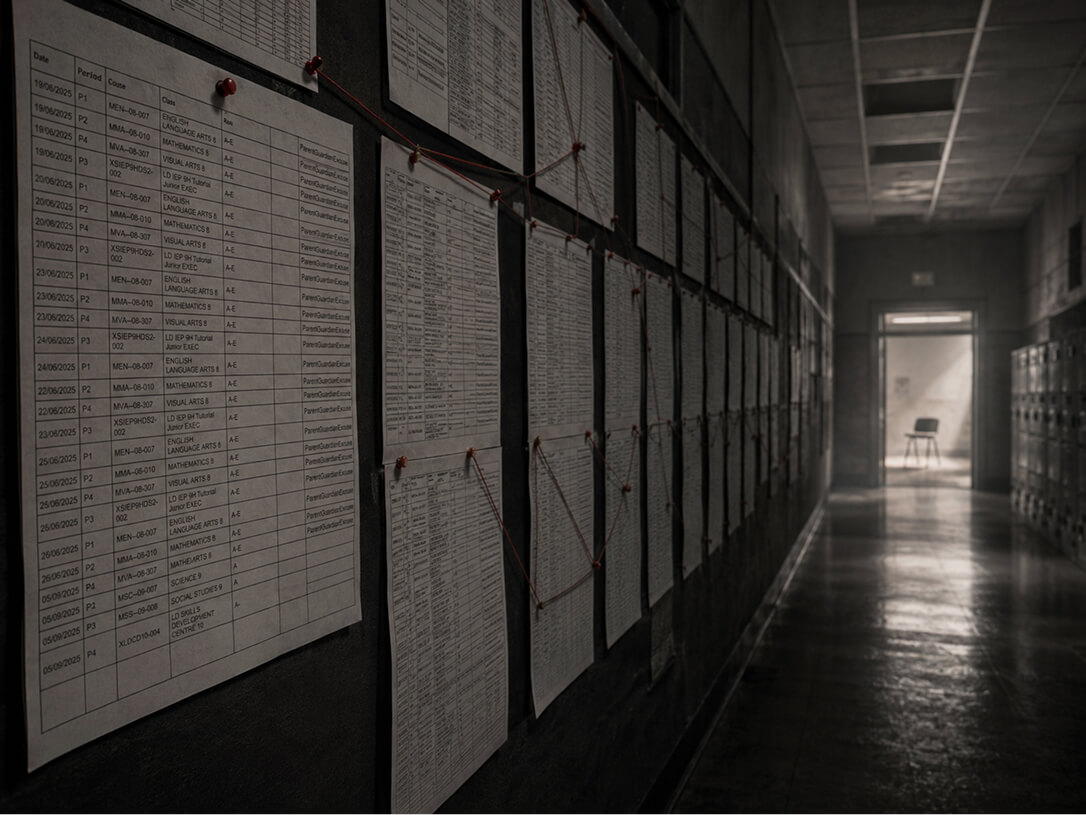
Designed for denial operates through several key mechanisms:
Burden of proof inversion
The system places the burden on the disabled child and family to prove accommodation is necessary, rather than on the institution to prove it is impossible. The parent must provide endless documentation – medical letters, psychological assessments, therapist reports, historical evidence – while the school can deny with “we don’t usually do that” or “I don’t think that’s necessary” and face no requirement to justify the refusal with evidence, data, or institutional rationale.
Also see: Documentation burden, Gatekeeping, Duty to accommodate, Goalpost shifting, Accessibility Frameworks
Gatekeeping without accountability
Decisions about accommodation are made by individuals (teachers, administrators) who face no consequences for denial, no oversight of their reasoning, and no requirement to document why they refused. The teacher who says “I just don’t think he needs that” is exercising gatekeeping power without accountability, and her subjective assessment – contaminated by bias, ideology, and personal discomfort – becomes determinative because there is no mechanism to interrogate whether her refusal is legitimate.
Also: see Gatekeeping, School Accountability, Accountability, Power dynamics, Institutional Harm
Epistemic hierarchy that privileges institutional interpretation
The system treats professional observation as more reliable than lived experience, medical diagnosis, or child testimony. The teacher’s perception that “she seems fine” overrides the parent’s documentation of nightly meltdowns, the paediatrician’s letter about first-percentile weight, and the child’s report of unbearable sensory assault, because the system has constructed an epistemic hierarchy where institutional authority is presumed objective and family knowledge is presumed biased, anxious, or exaggerated.
Also see: Gaslighting, Institutional betrayal, Double empathy, Parent Advocacy, Overqualified and disbelieved, Information asymmetry
Multiple redundant pathways to no
Even when one barrier is overcome, the system provides multiple alternate routes to denial. If you get the medical letter, the teacher can say “I don’t have time to implement that.” If you prove it takes minimal time, the administrator can say “it wouldn’t be fair to other students.” If you demonstrate it’s an individual medical need, they can say “we don’t have the resources.” If you show it’s zero-cost, they can say “it would set a precedent we can’t sustain.” The architecture ensures that no is always available through some pathway, no matter how much evidence you provide.
Also see: Goalpost shifting, Coercive proceduralism, Entrapment by policy, Shadow procedures, Documentation burden
Process as obstacle
The procedures for requesting accommodation are deliberately cumbersome, requiring forms that are not provided proactively, meetings that are scheduled at the school’s convenience, documentation that must be obtained at the family’s expense, and timelines that extend beyond the point where the accommodation would be useful. The process itself functions as a filter: families with resources, time, knowledge, and persistence may eventually obtain accommodation, while families without these advantages are screened out before the request is even formally considered.
Also see: Documentation burden, Coercive proceduralism, Procedural Fairness, Entrapment by policy, Burnout, Parent burnout
Accommodation as discretionary favour rather than human right
The system treats accommodation as something the school chooses to provide based on its assessment of whether the request is reasonable, rather than as a legal obligation to remove barriers to access. This framing allows the school to position itself as generous when it accommodates and justified when it refuses, rather than as potentially non-compliant when it denies a civil right. The language of “we’re happy to support where we can” rather than “we are legally required to provide access” reveals that the system understands accommodation as discretionary rather than mandatory.
Also see: No Discrimination, BC Human Rights Tribunal findings, Performative Accessibility, Lip service, Compliance over care
Siloed decision-making without pattern recognition
Each accommodation denial is treated as an isolated judgment call by an individual teacher or administrator, with no mechanism to track patterns, identify systemic barriers, or recognise that the same family is being refused again and again for the same reasons. The school does not maintain data on how many accommodation requests are denied, which types of accommodations are most frequently refused, which families are being systematically blocked, or whether certain biases (racial, gender, class) are shaping denial rates. Without pattern recognition, the system can frame each denial as a unique circumstance rather than evidence of structural refusal.
Also see: Data, Conduct Code Critiques, School Accountability, Accountability, Institutional Harm, Information asymmetry, Systemic Betrayal
Retaliation and relationship rupture for persistent advocacy
Families who continue to advocate after initial denial face escalating institutional hostility: the parent is labeled “difficult,” the child is scrutinised more harshly, and the relationship between family and school deteriorates to the point where advocating for accommodation becomes so costly – emotionally, socially, and in terms of the child’s daily experience – that many families abandon the request to preserve whatever fragile access remains. The system is designed so that pushing for accommodation makes things worse, and giving up is framed as “choosing to work collaboratively.”
Also see: Parent Advocacy, Fierce is Fair, Institutional betrayal, Tone Policing, Maternal rage, Coercive Control, Loss of faith in institutions
Performative process without substantive change
The system engages in extensive documentation, meeting attendance, and formal review processes that create the appearance of consideration while producing no actual accommodation. Meetings are held where the family’s concerns are “heard,” plans are drafted that include vague promises to “monitor” and “support,” and everyone agrees to “try some strategies,” but nothing changes because the process itself was the accommodation rather than a pathway to support. The performance of consideration substitutes for the provision of access.
Performative empathy, Lip service, Compliance over care, Entrapment by policy, Coercive proceduralism
Exit as solution
When families persist in requesting accommodation, the system increasingly suggests that the child might be “better served” in a different placement – a different school, a different program, homeschooling, private school, online school – positioning the child’s need as the problem to be removed rather than the institutional barrier to be dismantled. The system’s solution to accommodation denial is the child’s exit, which conveniently removes both the obligation to accommodate and the evidence that accommodation was refused.
Also see: Student Exclusion, Classroom Exclusion, Institutional betrayal, Systemic Betrayal, Punitive culture, School Trauma
-

Despair is there in the room, during the IEP
I was not such a bitch before my children were worn down by years of slow, grinding neglect. I became one through exposure. The tone, the edge, the precision that now startle others are the after-effects of advocacy conducted in hostile conditions. I used to be patient. I brought muffins to meetings and printed copies of policy so that everyone would feel informed. I believed that reason, research, and goodwill would be enough. I thought that kindness could make systems human. But belief cannot survive repeated contradiction. Every deferred accommodation, every meeting that ended in praise for effort instead of…
Designed for denial ensures that accommodation refusal is structurally embedded, individually unaccountable, procedurally protected, and ideologically justified. The system does not deny accommodation despite policies requiring inclusion; it denies accommodation through policies requiring inclusion, because the policies establish processes that function as barriers, create discretionary decision points controlled by biased gatekeepers, and provide no meaningful enforcement mechanism when denial occurs.
The result is a system where disabled children and their families must fight for access that is legally mandated, exhaust themselves overcoming barriers that are institutionally constructed, and accept that even when they win individual accommodations, the system remains fundamentally unchanged because it was designed to say no, and saying yes requires defeating the entire architecture of refusal rather than simply requesting support.
How it connects to designed for despair and designed for exhaustion:
- Designed for denial creates the structural refusal
- Designed for exhaustion ensures that fighting the denial drains all resources
- Designed for despair breaks the spirit of those who persist despite exhaustion
Together they form a complete system: the institution denies, the process exhausts, and the accumulation of denied accommodations plus drained resources produces the despair that makes families give up, withdraw, or accept that their child will not receive what they need. The design is integrated, deliberate, and devastatingly effective.
-

25 signs that your IEP team is disabling your child
In the space where families gather with school teams to shape a child’s Individual Education Plan, the language often carries more weight than paper can bear, for each phrase can open a door toward inclusion or quietly plant the seeds of exclusion, and the difference lies in whether the plan nourishes capacity or erodes it. An IEP built on deficit-driven thinking can slip, almost imperceptibly, into proposals that do not strengthen the child’s footing but instead chip away at it, introducing goals or conditions that act as a slow dismantling of confidence, access, and joy in learning. These ideas often…