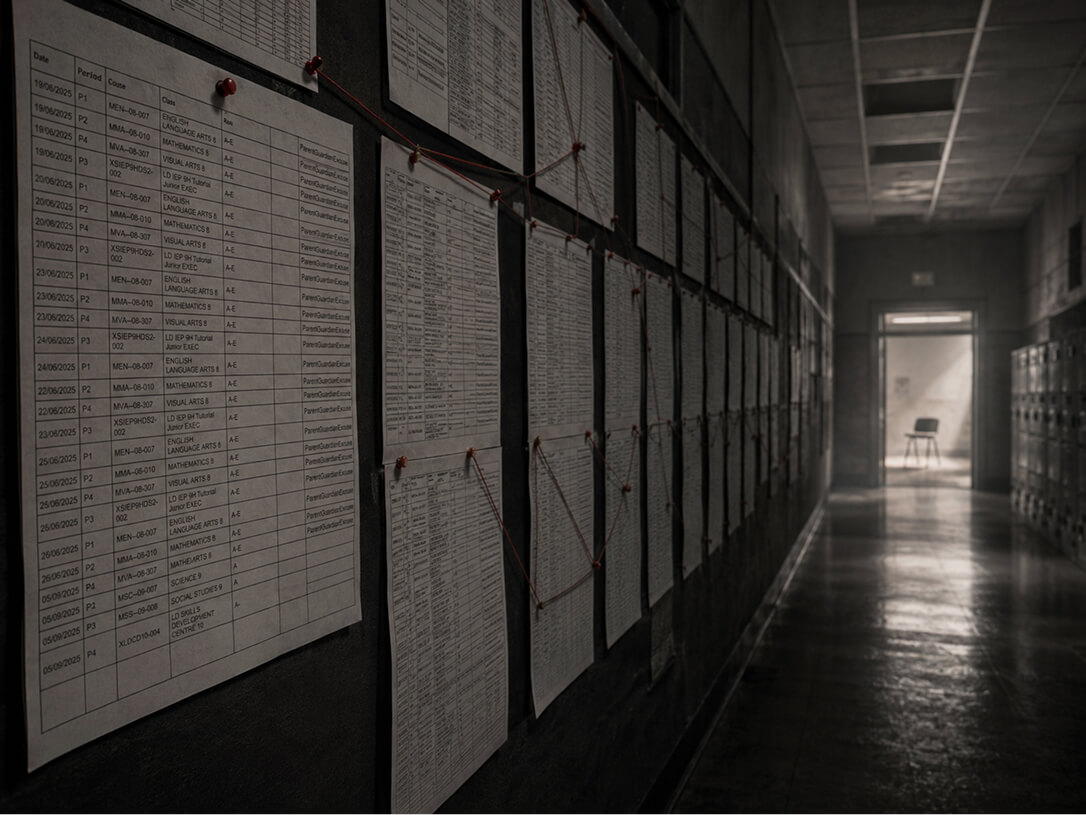
What families experience in schools is often described as a series of unfortunate incidents: a meltdown here, a missed accommodation there, a relationship breakdown framed as “complex family dynamics.” But these events are not random, isolated, or accidental. They are patterned. They recur across schools, districts, and provinces. They follow recognisable logics, deploy familiar language, and produce predictable harm.
This essay offers a taxonomy of those logics.
Rather than treating school harm as interpersonal failure, miscommunication, or individual bad actors, I name the structural mechanisms through which institutions extract labour, privatise responsibility, normalise boundary violations, disappear suffering, and then deny accountability for the damage they produce. These mechanisms are not hidden; they are embedded in policy, budget frameworks, staffing models, disciplinary codes, and values rhetoric. They persist because they are functional. They reduce costs. They maintain order. They protect institutions from scrutiny.
Taxonomies do important political work. They make patterns legible. They give people language for experiences they have been told are isolated, personal, or inevitable. They allow families to say, this has a name, and therefore this is not just happening to us.
What follows maps a set of recurring institutional moves—how schools conscript siblings into unpaid care work, moralise exploitation through “community values,” offload support into the private sphere, enforce scarcity as virtue, refuse to witness quiet suffering, and reframe predictable injury as family dysfunction. Alongside each mechanism, I draw on scholars who help name what is happening: not as pathology, but as structured violence.
This taxonomy is not exhaustive, and it is not abstract. It is built from lived experience—mine, and that of countless families navigating systems that claim inclusion while systematically producing harm. My aim is not only to analyse but to equip: to give parents, advocates, and educators language precise enough to interrupt the narratives that keep these practices intact.
Because once harm is named, it becomes harder to excuse. And once patterns are visible, institutions lose the protection of plausible deniability.
| What schools do | Why it’s violence | What you say | Link |
|---|---|---|---|
| Treat each meltdown as isolated | Refusal of pattern recognition protects the institution | This is a pattern produced by inadequate support. Name the system. | Institutional betrayal |
| Claim they’ve “never seen this before” | Institutional amnesia erases documented harm | Your own records show repetition. Stop erasing history. | Institutional harm |
| Frame distress as family dysfunction | Privatization of institutional failure | You’re offloading institutional harm onto families. | Privatisation of dysfunction |
| Suggest therapy instead of accommodation | Medicalization of access failure | Therapy doesn’t replace legal accommodation. | Accommodation refusal |
| Say the child must “build resilience” | Normalizing harm as growth | You’re demanding adaptation to injury. | Ableism |
| Praise masking as success | Rewarding self-erasure | Masking is labour, not wellness. | Masking |
| Ignore quiet suffering | Visibility bias | Distress doesn’t need to be disruptive to count. | Affective economies |
| Respond only to crisis | Engineered scarcity | You create emergencies, then react to them. | Designed for despair |
| Require repeated proof | Evidentiary violence | You already have sufficient information. | Documentation burden |
| Delay while requesting more data | Procedural stalling | Delay itself is harm. | Coercive proceduralism |
| Say resources are limited | Austerity as moral cover | Scarcity is a policy choice. | Scarcity logic |
| Compare child to others “who manage” | Disability hierarchy | Access isn’t comparative. | Rationing care |
| Frame accommodations as unfair | Sameness over equity | Equity is not advantage. | Unfairness |
| Use behaviour charts | Compliance over care | This manages optics, not needs. | Behaviourism |
| Remove privileges to control behaviour | Collective punishment | You’re punishing vulnerability. | Collective punishment |
| Withhold recess | Regulation deprivation | You’re removing regulation tools. | Withholding recess |
| Exclude child “temporarily” | Normalised exclusion | This is denial of education. | Classroom exclusion |
| Send child home for dysregulation | Offloading labour | You’re exporting your failure. | Bandwidth theft |
| Expect parents to be on call | Parent as infrastructure | You’ve conscripted unpaid labour. | Parent as procedural proxy |
| Use sibling as support | Forced care labour | Children aren’t staffing plans. | Sibling parentification |
| Praise helpful siblings | Gendered exploitation | Capacity is not consent. | Gendered care extraction |
| Allow boundary violations | Forced intimacy | Access doesn’t erase consent. | Mia Mingus |
| Call restraint “support” | Euphemistic violence | Name the harm accurately. | Euphemism |
| Downplay injuries | Institutional self-protection | Minimization compounds harm. | Institutional betrayal |
| Say they’re “doing their best” | Moral deflection | Intent doesn’t negate impact. | Accountability |
| Ask parents to collaborate “nicely” | Tone policing | Civility isn’t a prerequisite for rights. | Tone policing |
| Label advocacy as aggression | Silencing dissent | Advocacy is not misconduct. | Advocacy punished as aggression |
| Retaliate subtly after complaints | Coercive control | Retaliation violates policy and law. | Coercive control |
| Use PBIS without supports | Hollow reform | Frameworks without resources are harm. | Performative accessibility |
| Demand self-regulation without tools | Impossible standards | You’re setting the child up to fail. | Dysregulation |
| Ignore cumulative harm | Slow violence | Harm accrues even when subtle. | Designed to exhaust |
| Rotate staff constantly | Attachment rupture | Instability creates distress. | School trauma |
| Fail to document exclusions | Paper erasure | Lack of records doesn’t mean lack of harm. | Institutional amnesia |
| Use safety rhetoric to exclude | Risk displacement | You’re protecting the system, not the child. | Risk management |
| Blame parent burnout | Moral injury displacement | Burnout is produced, not personal. | Parent burnout |
| Ignore harm | Pretend the harm was inevitable | Some children are rendered invisible. | Grievability |
| Expect gratitude for minimal support | Emotional coercion | Basic rights aren’t favours. | Performative empathy |
| Ask parents to prioritize one child | Forced triage | You created scarcity, not us. | Engineered scarcity |
| Treat advocacy fatigue as disengagement | Punishing exhaustion | Fatigue signals harm, not apathy. | Advocacy fatigue |
| Escalate discipline after diagnosis | Diagnostic punishment | Diagnosis should increase support. | School to prison pipeline |
| Demand sameness in conduct codes | Structural exclusion | Uniform rules harm unevenly. | Neuronormative |
| Ignore lived testimony | Refusal to witness | Behaviour is not the full story. | Kelly Oliver |
| Gaslight parent accounts | Epistemic violence | Our testimony matters. | Gaslighting |
| Reframe harm as misunderstanding | Denial | This is a pattern, not confusion. | Epistemic silencing |
| Push care into the home | Public retreat | You’re privatizing public responsibility. | Nancy Fraser |
| Treat dysfunction as inherent | Naturalization of harm | This was produced here. | Designed for denial |
| Frame harm as inevitable | Fatalism | This was preventable. | Procedural fatalism |
| Say “this is how school works” | Normalized violence | Custom doesn’t equal justice. | Punitive culture |
| Punish disclosure | Silencing | Speaking up should not cost safety. | Whistleblowers |
| Reward hypercompliance | Survival masking | Compliance is not consent. | Hypercompliance |
| Ignore sibling fallout | Family systems blindness | You damaged relationships. | Sibling harm |
| Treat repair as parental job | Responsibility shift | Repair requires institutional change. | Systemic betrayal |
| Close the file at year’s end | Structural forgetting | The harm doesn’t reset in September. | Absence |
| Call harm “unfortunate” | Moral distancing | Language doesn’t absolve responsibility. | Ethics |
| Demand optimism | Toxic positivity | Reality isn’t negativity. | Toxic positivity |
| Frame resistance as negativity | Discipline of dissent | Naming harm is not hostility. | Feminist killjoy |
| Treat disabled children as burdens | Dehumanization | Children are not costs. | Eugenics |
| Preserve reputation over repair | Institutional self-interest | Protection of image caused this. | Preserve institutional reputation |
| Treat each school year as a clean slate | Institutional amnesia erases cumulative harm | You are resetting conditions you created. Harm does not reset annually. | Institutional amnesia |
| Refuse to connect repeated exclusions | Pattern denial prevents accountability | Repeated incidents indicate systemic failure, not isolated behaviour. | Designed for denial |
| Lose or fragment records across years | Information asymmetry protects institutions | Your record-keeping failure does not negate lived harm. | Information asymmetry |
| Require families to re-prove disability annually | Epistemic exhaustion | This is evidentiary violence, not due process. | Documentation burden |
| Recommend private therapy instead of accommodation | Marketizing public responsibility | Treatment cannot replace access. | Rationing care |
| Frame parental burnout as a family issue | Institutional displacement of cost | Your policies created this exhaustion. | Parent burnout |
| Reward quiet suffering | Affective compliance | Compliance is not consent. | Compliance culture |
| Punish advocacy tone | Silencing through professionalism | Advocacy is not aggression. | Fierce is fair |
| Say “it could be worse” | Comparative suffering | Harm is not relative. | Rationing care |
| Minimize impact by comparing to other families | Suffering Olympics | Every family’s experience is valid. | Epistemic silencing |
| Describe harm in clinical language | Affective flattening | Bureaucratic language hides violence. | Euphemism |
| Avoid words like hurt or harm or pain | Sanitizing reality | Accurate words honor experience. | Clarity |
| Frame exclusion as “best for everyone” | Utilitarian rhetoric | Collective benefit does not justify individual harm. | Necropolitics |
| Ignore successful home strategies | Knowledge refusal | If it works at home, adapt it here. | Evidence dismissal |
| Blame screen time or diet | Responsibilization | You’re deflecting from institutional failure. | Privatisation of harm |
| Suggest parenting classes | Condescension as policy | This is not a parenting problem. | Epistemic silencing |
| Refuse to communicate with separated parents equally | Weaponizing family structure | Both parents have legal rights to information. | Gaslighted by proxy |
| Use family conflict to delay services | Procedural exploitation | Family dynamics do not negate legal obligations. | Coercive proceduralism |
| Suggest child is manipulating parents | Adultification | Children do not manipulate; they communicate distress. | Deficit narrative |
| Frame different behaviour at school vs home as proof of capacity | Contextual erasure | Masking at school does not prove capacity; it proves fear. | Masking |
| Imply mothers are overprotective | Gendered dismissal | Protection is proportional to harm. | Maternal authority |
| Expect mothers to manage all communication | Gendered labour | Care coordination is not inherently maternal work. | Gendered expectations |
| Praise fathers for basic involvement | Gendered double standard | Involvement is baseline, not exceptional. | Gaslighted by proxy |
This taxonomy is intentionally and necessarily partial. The patterns are clear, but the work of naming them is labour-intensive, emotionally demanding, and unevenly borne by the very people most affected by the system. I have mapped some of the recurring institutional moves—documenting a selection, rather than all, and without exhaustive detail. Others remain unnamed here, reflecting the finite capacity required to document harm.
Institutions rely on this asymmetry. They expect families to be exhausted from tracking patterns, overwhelmed by cataloguing harm, and isolated from seeing their experiences as systemic. Taxonomy challenges that logic. Even partial naming strengthens the understanding that harm is structured, connected, and predictable. Each identified pattern makes the next easier to recognise, more visible, and increasingly accountable.
More rows will be added. More connections drawn. More language refined. That work will continue in 2026, as capacity allows, as energy returns, and as the need persists—because the structures that generate this harm remain intact.
For now, this taxonomy stands as both tool and testimony: a record of what has been named and evidence that what remains unnamed is not unknowable—only deferred. If you recognise your family’s experience in even one of these rows, know this: your experience is part of a pattern, and your exhaustion reflects the predictable cost of surviving systems that are structured around maintaining harm.
Rest up my friends. There’s a revolution ahead.
Happy New Year.
-

The good twin, the bad twin, and the system that needed both
Before school taught them roles, they played tea party—taking turns serving and being served. Seven years later, I can’t say with certainty whether one would fetch the fire extinguisher if the other caught flame.